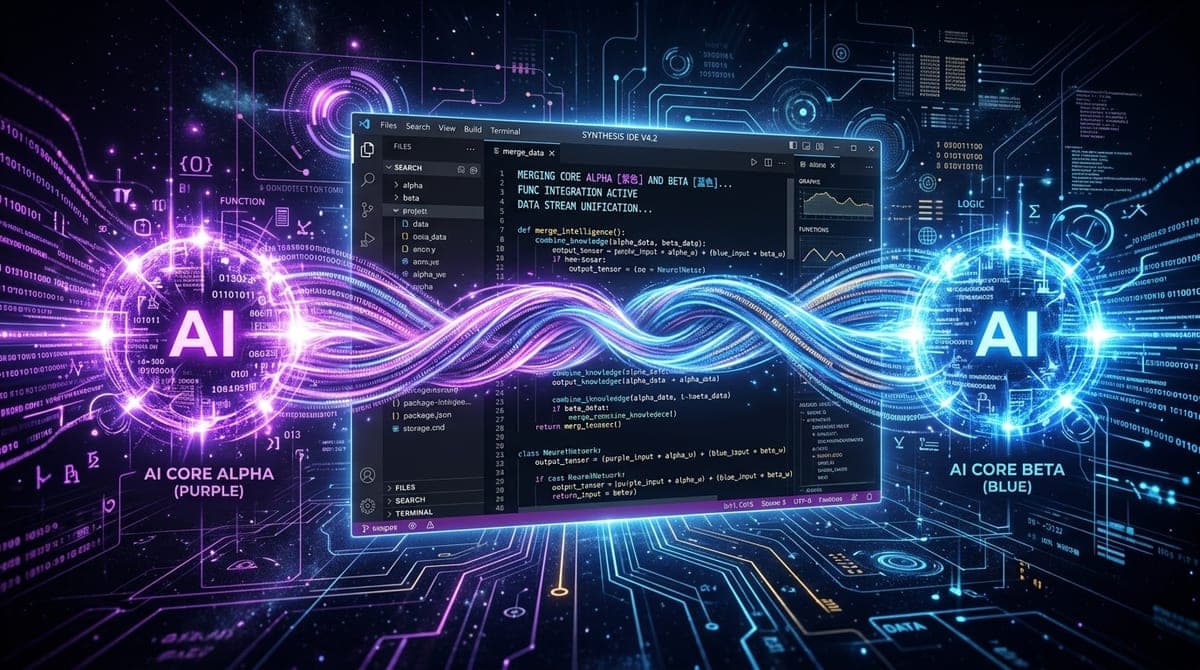
SpaceX Buys Cursor for $60B: The AI Coding War Between ChatGPT, Claude, and Gemini

The AI coding landscape just experienced a seismic shift. In a move that shocked the tech world this week, SpaceX announced the acquisition of Cursor for a staggering $60 Billion. This isn't just about rockets; it's about the race for autonomous software engineering.
Cursor has become the absolute standard for AI-assisted coding, but the real war is happening in the backend. With SpaceX now backing Cursor, the platform is poised to become the battleground where the world's most advanced frontier models—ChatGPT, Claude, and Gemini—fight for dominance in the "Agentic Era" of development.
The $60 Billion Play
Why did SpaceX buy a coding IDE? The answer lies in autonomous agentic workflows. SpaceX's engineering complexity requires massive amounts of code for simulations, telemetry, and spacecraft operations. By owning Cursor, SpaceX not only secures the premier tool for its own developers but also positions itself as a gatekeeper in the AI ecosystem.
Cursor's new native iOS app is already changing how developers manage code on the go, but the platform's true power lies in its ability to harness multiple large language models (LLMs) to write, debug, and deploy entire repositories autonomously.
The Contenders: Who Will Power the Agentic Future?
As Cursor scales under its new ownership, developers are constantly evaluating which model provides the best backend intelligence. Let's look at the current state of the "Big Three":
1. Claude Sonnet 5 (Anthropic)
Released just last week (June 30, 2026), Claude Sonnet 5 has quickly become the default model for many Cursor users. Anthropic focused heavily on agentic capabilities—giving Claude the ability to interact directly with terminals, browsers, and complex file structures. It performs remarkably close to their flagship Opus 4.8 model but with significantly lower latency. For developers building autonomous workflows, Claude Sonnet 5 is currently the gold standard for long-context understanding.
2. GPT-5.6 Preview (OpenAI)
OpenAI is not sitting still. They are currently previewing GPT-5.6 to government-vetted partners and select enterprise clients. Building on the native omnimodal capabilities of GPT-5.5, the 5.6 update focuses on zero-shot reasoning for complex software architecture. While standard ChatGPT users don't have access yet, enterprise developers report that GPT-5.6 has a remarkable ability to spot security vulnerabilities across thousands of lines of code.
3. Gemini 3.5 Pro (Google)
Google's Gemini 3.5 Pro is currently in a limited enterprise preview, having faced some launch delays as Google focused on optimizing token consumption. This is a critical factor: as AI agents take over more autonomous tasks, the cost of running them skyrockets. Google's strategy with Gemini 3.5 Pro is to offer massive context windows (millions of tokens) at a highly optimized cost, making it the most economical choice for long-horizon agentic tasks in Cursor.
The Verification Bottleneck
With AI writing more code than humans in 2026, the industry is facing a new problem: verification. Who checks the AI's work?
This is where independent verification layers are gaining traction. Tools like Qodo are becoming essential, acting as a secondary AI that strictly reviews the code generated by Cursor's primary LLMs. We are moving from "AI coding" to "AI peer review," where Claude might write the code, and Gemini might audit it for security flaws.
What This Means for Developers
The SpaceX acquisition signals that AI coding tools are no longer just helpful autocomplete utilities; they are critical infrastructure for the world's most advanced companies.
For everyday developers, this means the tools are going to get much smarter, much faster. If you haven't transitioned your workflow to an agent-first IDE like Cursor, you are already falling behind. The models—whether it's ChatGPT, Claude, or Gemini—are ready to take the wheel. The only question is which one you'll choose to drive.
David tests AI tools, gadgets, and developer platforms hands-on before writing about them. His work focuses on making complex tech approachable — without the hype. He has covered 100+ products across AI, gadgets, and software for TechPixelly.