Smart Glasses 2026: AR Overlays and Real-Time Translation
The year is 2026, and the wearable technology landscape has shifted in a way that many predicted but few fully comprehended until it became our daily reality. We have officially moved past the era of looking down at our smartphones. Instead, we are looking up, looking forward, and seeing the world through a new lens—literally. Smart glasses have finally achieved the holy grail of consumer tech: they are stylish, they are lightweight, and they are packed with features that fundamentally alter how we interact with our environment. The two most groundbreaking features that have driven this mass adoption? Seamless Augmented Reality (AR) overlays and flawless, instantaneous real-time translation.
In this comprehensive guide, we will dive deep into how smart glasses in 2026 have evolved, the underlying technologies that make these features possible, the best models currently on the market, and what this shift means for privacy, society, and our collective future.
The Journey to 2026: From Clunky Prototypes to Everyday Wear
To truly appreciate the marvel of today's smart glasses, we have to look back at the rocky road that brought us here. Over a decade ago, early iterations like Google Glass introduced the concept of a heads-up display (HUD) to the public. While technologically ambitious, they were plagued by poor battery life, socially awkward designs (the infamous "glasshole" era), and massive privacy concerns. Following that, we saw incremental improvements from companies like Snap and Meta, who focused heavily on camera-equipped sunglasses rather than full AR.
Then came the mixed reality headsets—bulky, expensive, and tethered to indoor environments. They proved the concept of AR was viable and incredibly useful, but they were not something you would wear on a walk in the park or at a coffee shop.
The breakthrough in the mid-2020s came through a convergence of several distinct technological leaps:
- Micro-LED Displays: These allowed for incredibly bright, high-contrast images to be projected onto regular-looking lenses without bulky projectors.
- Solid-State Batteries: Providing all-day battery life without the weight or thermal issues of traditional lithium-ion cells.
- Edge AI and NPU (Neural Processing Unit) Advancements: Allowing complex calculations, like spatial mapping and language translation, to happen on the device itself with zero latency, rather than relying on a constant, high-bandwidth cloud connection.
Today, smart glasses look virtually indistinguishable from a standard pair of Ray-Bans, Warby Parkers, or Oliver Peoples. Yet, hidden within their sleek frames is more processing power than the laptops of a decade ago.
The Magic of AR Overlays
The most immediately noticeable benefit of 2026's smart glasses is the integration of Augmented Reality overlays. Unlike Virtual Reality, which completely immerses you in a digital world, AR overlays digital information onto the physical world you are already seeing.
Context-Aware Navigation
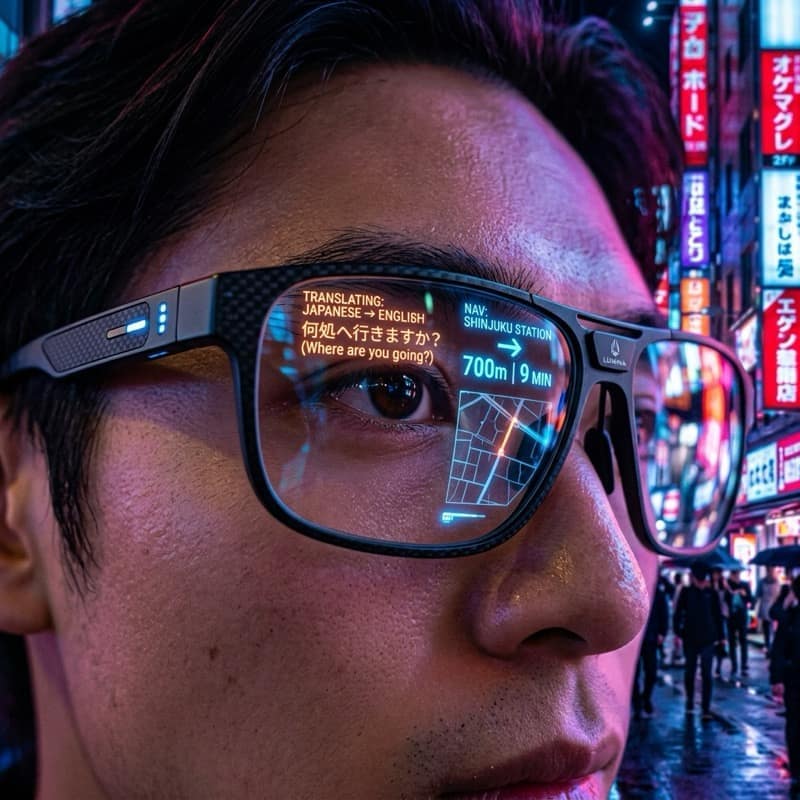
Gone are the days of staring at a blue dot on your phone while trying to navigate a busy city intersection. Modern smart glasses provide turn-by-turn navigation by painting glowing, holographic arrows directly onto the streets and sidewalks in front of you. If you are walking through Tokyo looking for a specific ramen shop, your glasses will highlight the exact alleyway you need to turn down, displaying the distance and estimated time of arrival hovering just above the pavement. This context-aware navigation also extends indoors. Trying to find your gate at a massive international airport? Your glasses will guide you past the crowds directly to your seat.
Real-Time Information Delivery
AR overlays function as a personalized, non-intrusive dashboard for your life. When you look at a restaurant, your glasses can pull up its rating, menu, and availability, displaying the information subtly in your peripheral vision. If you are at a networking event, facial recognition (if opted into by both parties) can softly float a person's name and LinkedIn title next to their face, saving you from the embarrassment of forgetting a contact's name.
Furthermore, this technology integrates seamlessly with IoT (Internet of Things) devices. Look at your smart thermostat, and the current temperature and settings appear; look at your refrigerator, and it highlights what groceries you are running low on. The physical world has become an interactive canvas.
Immersive Entertainment and Work
For productivity, AR overlays have replaced multiple monitor setups. By connecting wirelessly to your smartphone or pocket-compute module, your glasses can project multiple virtual screens around your workspace. You can have a virtual Slack channel on your left, a massive 4K spreadsheet in the center, and a YouTube video playing on the right, all while sitting at a tiny cafe table. No one else can see what you are looking at, providing ultimate privacy for your work.
Breaking Down Babel: Real-Time Translation
While AR overlays change how we see the world, real-time translation changes how we connect with it. The concept of a universal translator has been a staple of science fiction for decades, from Star Trek to The Hitchhiker's Guide to the Galaxy. In 2026, it is a reality.
How It Works
Previous translation apps required you to pull out a phone, press a button, speak, wait for the processing, and then have the phone speak back. It was clunky and killed the natural flow of conversation.
Modern smart glasses utilize highly directional, noise-canceling beamforming microphones that isolate the voice of the person you are looking at, even in a crowded, noisy environment. The on-board NPU processes the audio locally, transcribing it instantly.
From here, the glasses do two things simultaneously:
- Audio Translation: Through bone-conduction speakers hidden in the arms of the glasses, you hear a synthesized voice translating the speaker's words into your native language. The latency is almost imperceptible, often clocking in at under 100 milliseconds.
- Visual Subtitles: The AR overlay projects translated subtitles in the lower third of your field of vision, perfectly synced with the speaker's lip movements.
The Impact on Global Travel and Business
The implications for travel are staggering. You can walk into a market in Marrakech, a business meeting in Seoul, or a rural village in Italy and communicate with absolute ease. The anxiety of the language barrier has been completely erased. You can read menus, street signs, and historical plaques instantly, as the AR overlays replace the foreign text with your native language, matching the font and style of the original sign.
In the business world, international deals are being struck faster and with more clarity. Subtle nuances in tone and idiom are being handled better than ever, thanks to Large Language Models (LLMs) that understand context, sarcasm, and cultural phrasing, rather than just delivering rigid word-for-word translations.
Top Contenders in 2026: The Hardware You Need to Know
With the technology finally maturing, several major players have entered the market with highly refined consumer devices. Here are the top smart glasses leading the charge in 2026.
1. Lumina Vision Pro Gen 2
Lumina has taken the market by storm with their Vision Pro Gen 2. They focused heavily on the optical quality, utilizing a proprietary waveguide technology that offers the widest field of view (FOV) in the industry without making the lenses look thick or insect-like.
Their real-time translation engine is powered in partnership with leading AI firms, offering offline translation for over 100 languages. The frame is constructed from a titanium-carbon alloy, making it both incredibly durable and light enough to wear for 14 hours straight.

The Lumina Vision Pro Gen 2 also features advanced gesture controls. Tiny, imperceptible finger twitches picked up by the cameras in the frame allow you to scroll through menus, dismiss notifications, or select text without ever raising your hand or using a clunky ring accessory.
2. Meta Ray-Ban Horizon
Meta continued their highly successful partnership with EssilorLuxottica to produce the Horizon line. If Lumina is for the tech enthusiast, the Meta Ray-Ban Horizon is for the fashion-conscious consumer. To the untrained eye, these look exactly like a classic pair of Wayfarers or Aviators.
Meta has leveraged their massive social ecosystem to make the Horizon glasses the ultimate social tool. The AR overlays are deeply integrated with WhatsApp and Instagram, allowing you to see messages float in your peripheral vision and respond with subtle voice commands. Their real-time translation is excellent, though it leans slightly more on cloud processing, meaning you need an active 5G/6G connection for the most obscure languages.

The Horizon also features exceptional spatial audio. Whether you are listening to a podcast or on a phone call, the sound feels like it is emanating from the environment around you, completely eliminating the need for earbuds.
3. Apple Glass (Series 2)
Apple's entry into the lightweight smart glasses market (following their larger Vision Pro headset) did what Apple does best: it normalized the technology. The Apple Glass Series 2 integrates so flawlessly into the Apple ecosystem that it feels indispensable if you already own an iPhone or an Apple Watch.
Their AR overlays are unparalleled in their graphical fidelity, rendering shadows and lighting that perfectly match the real world. Their translation feature, tied closely to an upgraded, hyper-intelligent Siri, is highly conversational. Apple's focus on privacy means all translation and AR mapping is done on-device via their dedicated R-series silicon chips, ensuring none of your visual data ever goes to the cloud.
Design and Aesthetics: The End of the "Tech Bro" Look
One of the biggest hurdles for early smart glasses was the stigma of looking like a cyborg. In 2026, that stigma is dead. The miniaturization of components has reached a point where the logic board, battery, and sensors fit entirely within a standard 4mm thick frame arm.
Consumers can now choose from hundreds of styles, from thick, bold acetate frames to wire-thin minimalist designs. Prescription lenses are easily accommodated, and most models feature electrochromic dimming. This means the lenses can transition from completely clear indoors to dark sunglasses outdoors in less than a second, adjusting automatically to the ambient light to ensure the AR overlays are always visible.
The customization is endless. Companies offer bespoke fitting processes where your face is 3D-scanned via an app, and the frame is 3D-printed to match the exact topography of your nose bridge and ears, ensuring they never slip or cause pressure headaches.
The Dark Side of the Lens: Privacy and Ethics
It would be irresponsible to discuss the proliferation of smart glasses without addressing the massive elephant in the room: privacy. We are now living in a world where millions of people are walking around with always-on, high-definition cameras and highly sensitive microphones strapped to their faces.
The Death of Anonymity?
In the early 2020s, there was intense debate about facial recognition in public spaces. In 2026, it is a reality we are actively navigating. While companies like Apple and Meta have implemented strict "opt-in" protocols for social identification (meaning your name won't float above your head unless you explicitly allow it to be broadcast to others' glasses), malicious third-party apps remain a concern.
Legislative Responses
Governments around the world have had to scramble to pass the "Wearable Privacy Acts of 2025." These laws mandate strict hardware indicators—such as un-hackable, hardwired LED lights on the front of the frames that illuminate brightly whenever recording or spatial mapping is taking place. Furthermore, public spaces like locker rooms, certain government buildings, and private clubs have instituted digital geofencing, which automatically disables the camera and microphone functionality of any glasses entering the premises.
Data Security
With AR glasses mapping the inside of our homes, our offices, and our daily routines to provide context-aware information, the data they collect is incredibly intimate. The industry has largely shifted to local processing, keeping this data on the device, but the risk of hacking remains. Consumers must be as vigilant about their eyewear security as they are about their bank accounts.
Battery Life and Processing Power: The Silent Revolution
How do you power a high-resolution display, multiple cameras, depth sensors, and a neural processor in a device that weighs 45 grams? The answer lies in the silent revolution of battery and display technology.
Solid-State Batteries
Traditional lithium-ion batteries simply couldn't scale down while retaining enough energy density for AR glasses. The widespread commercialization of solid-state batteries in late 2024 changed everything. These batteries are safer, can be shaped to fit the contours of the glasses' arms, and hold a charge three times longer. Most smart glasses in 2026 can easily last a full 16-hour day of standard use.
Micro-LED and Waveguides
The displays themselves draw incredibly little power. By utilizing micro-LEDs that only light up the specific pixels needed for the AR overlay (leaving the rest of the lens transparent), power consumption is minimized. The waveguide technology bounces this light through the lens directly into the wearer's retina, providing a crisp image even in direct sunlight without requiring a blindingly bright backlight.
What's Next? Looking Toward 2030
If 2026 is the year smart glasses became mainstream, what does the next evolution look like? The industry is already teasing the advancements of the 2030s.
We are beginning to see the early stages of Brain-Computer Interfaces (BCI) being integrated into wearable tech. While we aren't quite at the point of telepathy, next-generation glasses may use non-invasive neural sensors built into the arms to detect the wearer's intent. Imagine simply thinking about scrolling down a webpage, and the AR overlay responds.
Furthermore, smart contact lenses are steadily moving from the R&D labs into clinical trials. While they won't replace glasses for complex AR tasks anytime soon, they will soon handle basic notifications and health monitoring directly on the surface of the eye.
Conclusion: A New Way of Seeing
The transition to smart glasses is as significant a paradigm shift as the move from desktop computers to smartphones. They are removing the friction between digital information and the physical world. With AR overlays, our environments are richer, more informative, and infinitely customizable. With real-time translation, the world has become smaller, friendlier, and more accessible.
While we must remain vigilant about privacy and the ethical use of this technology, the benefits are undeniable. We are no longer looking down at screens; we are looking up at the world, enhanced and translated in real-time. The future is here, and it looks remarkably clear.
Swayam tests AI tools, gadgets, and developer platforms hands-on before writing about them. His work focuses on making complex tech approachable — without the hype. He has covered over 75 products across AI, gadgets, and software for TechPixelly.