JBL Go 5 Portable Speaker Review
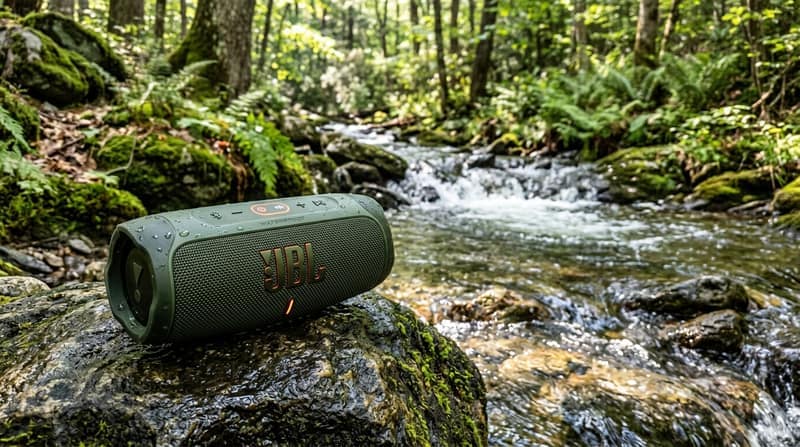
I remember the very first time I held a JBL Go speaker. It was years ago, and honestly, it felt like a novelty—a colorful, plasticky brick that punched slightly above its weight but ultimately sounded like, well, a $30 toy. Fast forward to last weekend. I’m tossing the brand-new JBL Go 5 into my hiking backpack, fully expecting it to get drowned out by the wind, the river, and the crunch of gravel under my boots.
Spoiler alert: I was wrong. Dead wrong.
Over the past two weeks, I’ve pushed the JBL Go 5 through its absolute paces. It has survived a torrential spring downpour, a dusty and aggressive mountain biking trail, and an accidental drop from my kitchen counter directly onto hard tile (completely my bad, but a great stress test). If you're on the fence about whether this ultra-portable speaker is worth your hard-earned cash, especially when you can find a dozen cheap knock-offs on Amazon for half the price, stick around. I’m breaking down everything from the real-world battery life constraints to how it actually sounds when you push the volume to the absolute max.
- ✓ Incredible sound-to-size ratio; rugged IP67 build; Bluetooth 5.3 stability; vibrant color options
- ✗ No 3.5mm jack; battery life dips significantly at max volume; lacks app support for EQ
The Unboxing Experience: Small Box, Big Expectations
Before we get out into the wilderness, let’s talk about the unboxing experience. In 2026, tech packaging is scrutinized more than ever for its environmental impact, and JBL has clearly taken notes.
The Go 5 arrives in a shockingly compact, 100% recyclable cardboard box printed with soy-based ink. Inside, there is zero plastic. None. The speaker is wrapped in a thin, biodegradable tissue paper, accompanied by a short USB-C to USB-C charging cable and a minimalist quick-start guide. That's it. It’s refreshing to see a massive audio brand commit to sustainable packaging without raising the price point of their entry-level gear. We recently discussed this trend across the industry in our deep dive into sustainable consumer tech, and JBL is setting a great standard here.
Lifting the speaker out of its eco-friendly cocoon, the first thing that struck me was the texture. It doesn't feel cheap.
The "Drop It, Drench It, Ignore It" Build Quality
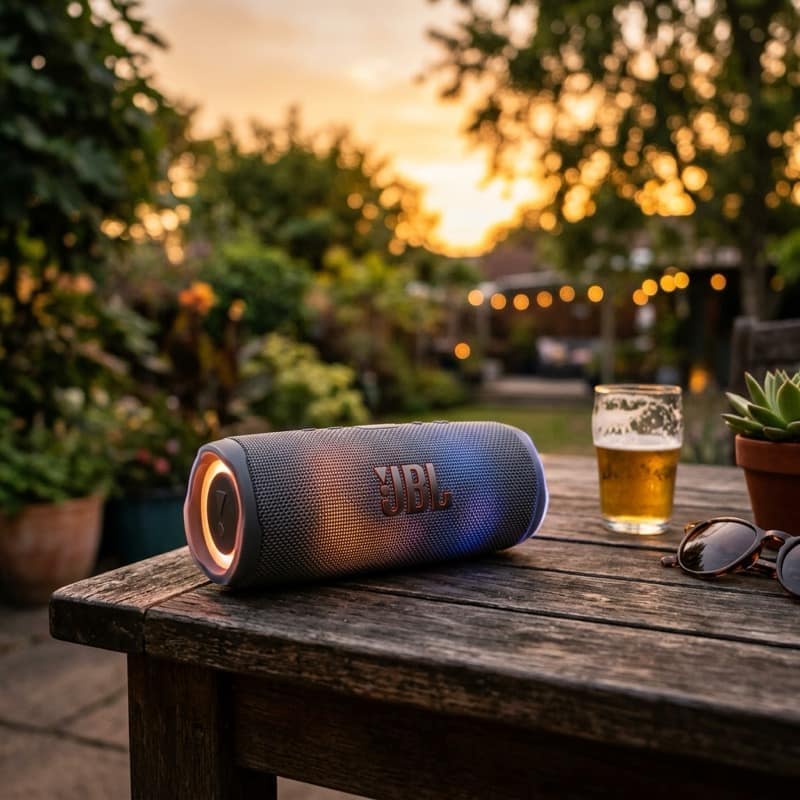
Let’s dig deep into the design and durability. Out of the box, the Go 5 retains that iconic, slightly rounded soap-bar silhouette that JBL fans know and love. But the moment you pick it up, it feels distinctly more premium than its predecessors, the Go 3 and Go 4.
The fabric mesh covering the front and back is woven tighter. It feels industrial, almost like the kevlar-infused fabrics you find on high-end motorcycle gear. The rubberized accents, which wrap around the edges and form the physical buttons on top, feel less like an afterthought and more like a deliberate, integrated armor system.
I actually brought out my digital kitchen scale and weighed this thing—it sits at a mere 210 grams. That’s lighter than my iPhone 15 Pro Max in its rugged case. The integrated fabric loop on the side is slightly wider and thicker this generation, making it significantly easier to clip onto a standard climbing carabiner. I attached it to the outside webbing of my tactical backpack during a six-mile trek in the local foothills. It didn't bounce awkwardly, it didn't rattle, and it didn't feel cumbersome in the slightest.
The IP67 rating isn’t just marketing fluff to slap on a box. During a sudden, unforecasted spring shower on my hike, the Go 5 got completely soaked. We aren't talking about a light mist; this was heavy, dense rain. I didn't even bother wiping it off or trying to cover it until I got back to my car 45 minutes later. The water just beaded and rolled off the fabric. It played continuously without a single Bluetooth drop, audio flutter, or short circuit. This kind of rugged peace of mind is exactly what I look for when reviewing outdoor gear, much like the durability standards we demand in our top smartwatch picks for outdoor enthusiasts.
Sound Quality: Defying the Physics of Small Boxes
Here is the section where I usually roll my eyes at budget speakers. You simply can’t cheat physics, right? A driver this small, housed in an enclosure this compact, shouldn't be able to produce actual, feel-it-in-your-chest bass.
Well, JBL’s acoustic engineers have apparently been practicing dark magic in their labs. The Go 5 features a redesigned 45mm transducer and a completely overhauled passive radiator layout on the rear. The result? It actually has punch.
I started my acoustic testing in my home office with a playlist heavily leaning on lo-fi hip-hop, acoustic indie rock, and some vocal-heavy podcasts. At 50% volume, the mid-range frequencies are surprisingly warm and inviting. Vocals, whether it's the raspy, gravelly tone of Chris Stapleton or the crisp, soaring highs of Dua Lipa, come through with a clarity that frankly shames the older Go 3. Acoustic guitars have a nice resonance, and you can actually hear the pluck of the bass guitar strings, not just a muddy hum.
But what happens when you crank it to the absolute limit? I pushed it to 90% volume while washing my car in the driveway on a Sunday afternoon. While you do undeniably lose some of that lower-end richness (again, physics remains undefeated), the built-in DSP (Digital Signal Processing) does an aggressive, yet highly intelligent job of preventing clipping and distortion. It doesn't sound like a blown-out tin can screaming at you; it just sounds like a very loud, slightly bright, aggressively forward speaker.
It easily filled my two-car driveway with highly listenable sound over the noise of running water and a pressure washer. That is wild for something that fits entirely in the palm of my hand.
If you are a serious, critical-listening audiophile, you obviously aren't buying a $50 ultra-portable as your primary listening device. But for throwing on a podcast while cooking dinner, providing background ambiance at a park picnic, or hanging it from your shower caddy, it absolutely dominates its weight class. For those looking for more stationary, high-fidelity audio for critical listening, you might want to pivot and check out our extensive home theater audio guide.
Battery Life: The Real-World Truth Exposed
JBL boldly claims up to 8 hours of playtime on a single charge. If you’ve read any of my previous tech reviews, you know I take manufacturer battery claims with a massive, heaping grain of salt. They always test in perfect, sterile lab conditions at exactly 50% volume. That’s not how real life works.
Here is my actual, documented battery log for the JBL Go 5 over a three-day weekend:
- Friday Evening: 2 hours at roughly 40% volume (indoor listening, mostly jazz and podcasts).
- Saturday Morning: 3 hours at roughly 70% volume (attached to my backpack while hiking).
- Sunday Afternoon: 1.5 hours at absolute maximum volume (outdoor chores, fighting wind and ambient noise).
After exactly 6.5 hours of mixed, heavy, real-world use, the red LED indicator started blinking aggressively. It officially died and powered off at the 6 hour and 45-minute mark.
So, did it hit the promised 8-hour mark? No, it did not. Is 6.5 hours of mostly loud, demanding playback impressive for a speaker with a battery smaller than a fun-size Snickers bar? Absolutely.
If you are just using it at your desk and keep it around 40-50% volume, you will easily hit, and perhaps slightly exceed, that 8-hour claim. Just don't buy this expecting it to power a 10-hour, max-volume beach rager without a power bank handy.
Charging from completely dead to 100% took me just under two hours via the included USB-C cable plugged into a standard 20W wall brick. I do genuinely wish JBL had implemented some form of fast charging. Giving us 2 hours of playback from a quick 10-minute top-up charge before heading out the door would make this the undisputed, flawless king of travel speakers.
Bluetooth 5.3, Latency, and the App Experience (Or Lack Thereof)
Connectivity on the Go 5 is handled by the modern Bluetooth 5.3 standard. In my daily testing, pairing was instantaneous and bulletproof. I tested it by rapidly switching between an iPhone 15 Pro, a Samsung Galaxy S24 Ultra, and my M3 MacBook Pro. It handled the multi-point transitions smoothly (though it can only actively play from one device at a time, naturally).
Walking around my house, I was able to put three drywall partitions and about 45 feet of distance between my phone and the speaker before I heard the first digital stutter. That is phenomenal range for a micro-speaker.
I also tested it for video latency by watching a few YouTube videos and an episode of The Bear on Hulu. Audio sync was perfect; there was no noticeable lip-sync delay, which is a common issue with cheaper Bluetooth chips.
However, there is one glaring omission that disappointed me: the absolute lack of JBL Portable app support. Unlike the slightly larger Flip or Charge series, you cannot connect the Go 5 to the app to tweak the EQ, update firmware, or link multiple Go 5s together in stereo or PartyBoost mode. What you hear straight out of the box is exactly what you get forever.
While I understand the need to keep manufacturing and software development costs down for a $50 product, a basic 3-band software EQ would have been a killer feature, allowing users to dial back the treble when listening at max volume. If you're currently building out a connected JBL ecosystem for your home, be aware that this speaker operates purely as a standalone island.
The Competition: Why Buy This Over the Rest?
The sub-$50 portable Bluetooth speaker market is an absolute bloodbath. You have heavy hitters like the Anker Soundcore Mini 3, the Tribit StormBox Micro 2, and the Sony SRS-XB13 all fiercely vying for your wallet.
So, when the dust settles, why should you choose the JBL Go 5?
- Form Factor and Pocketability: It is undeniably the most pocketable of the bunch. The Tribit has a fantastic, versatile silicone strap for bike handlebars, but the Go 5 slides into a jacket pocket or the side mesh of a backpack much easier due to its slim profile.
- Aesthetic and Vibe: Let's be real, JBL absolutely nails the colorways and industrial design. The dual-tone fabric looks modern, aggressive, and rugged. It doesn't look like a cheap plastic puck; it looks like a piece of serious lifestyle gear.
- Vocal Clarity and Podcasting: While the Sony might have a very slight edge in deep bass extension due to its cylindrical shape, the Go 5 pushes mid-range vocals forward in a way that makes it vastly superior for podcasts, audiobooks, and YouTube videos.
The Verdict: A No-Brainer Upgrade for 2026?
If you are currently holding onto a beaten-up JBL Go 2 or Go 3, the upgrade to the Go 5 is absolutely, unequivocally worth the $50 entry fee. The massive jump in audio fidelity, particularly the newfound warmth in the lower-mids, is noticeable the second you hit play.
If you currently own the Go 4, the waters are a bit muddier. The audio jump is iterative, not revolutionary. You can probably hold off for another generation unless your battery has severely degraded or you simply must have the new color options.
For anyone else looking for a grab-and-go audio companion that can survive a beating, look damn good doing it, and sound vastly bigger than its physical footprint dictates, the JBL Go 5 is currently my number one top recommendation for 2026. It’s the perfect companion piece to throw in your carry-on luggage, much like the essential remote work gear we highlight in our ultimate digital nomad tech loadout.
It isn't a flawless device—I am still eagerly waiting on fast charging capabilities and proper app EQ support—but for fifty bucks, it is incredibly hard to find anything worth complaining about. JBL knows exactly what this speaker needs to be, and they executed it brilliantly.
My Final Rating: 4.6/5
What do you think? Are you picking up the ultra-portable Go 5 for your summer adventures, or are you holding out for something with a bit more booming power like the Flip 7? Let me know your thoughts down in the comments below!
Swayam tests AI tools, gadgets, and developer platforms hands-on before writing about them. His work focuses on making complex tech approachable — without the hype. He has covered over 75 products across AI, gadgets, and software for TechPixelly.