How to Use AI Betting Predictors for FIFA World Cup 2026
TL;DR
- The 2026 Shift: With 48 teams competing in the FIFA World Cup 2026, the variables for predicting match outcomes have skyrocketed.
- AI's Role: AI betting predictors analyze vast amounts of data (historical stats, weather, player sentiment) far faster and more accurately than a human ever could.
- How to Start: Choose a reliable AI tool, understand the metrics it provides (like xG or expected goals), and integrate it into a disciplined bankroll management strategy.
- The Golden Rule: AI is a powerful assistant, not a crystal ball. Always combine machine learning insights with your own contextual knowledge of the beautiful game.
Introduction: The New Era of Football Analytics
The FIFA World Cup 2026 is poised to be the biggest tournament in the history of the sport. Spanning across three nations—the United States, Canada, and Mexico—and featuring an expanded format of 48 teams, the sheer scale of the competition is unprecedented. For football fans, it’s a month-long festival of the beautiful game. For sports bettors, it’s a complex puzzle with an overwhelming number of variables.
In the past, predicting the outcome of a World Cup match meant pouring over recent form guides, relying on gut feelings, or following the advice of sports pundits. Today, the game has changed. The rise of Artificial Intelligence (AI) and machine learning has democratized access to the kind of predictive analytics that were once reserved for elite syndicates and Vegas oddsmakers.
If you are looking to gain an edge during the 2026 World Cup, learning how to use AI betting predictors is no longer optional—it's essential. In this comprehensive guide, we will walk you through exactly what these tools are, how they work, and the best strategies for using them to make smarter, data-driven wagers.
What Are AI Betting Predictors?
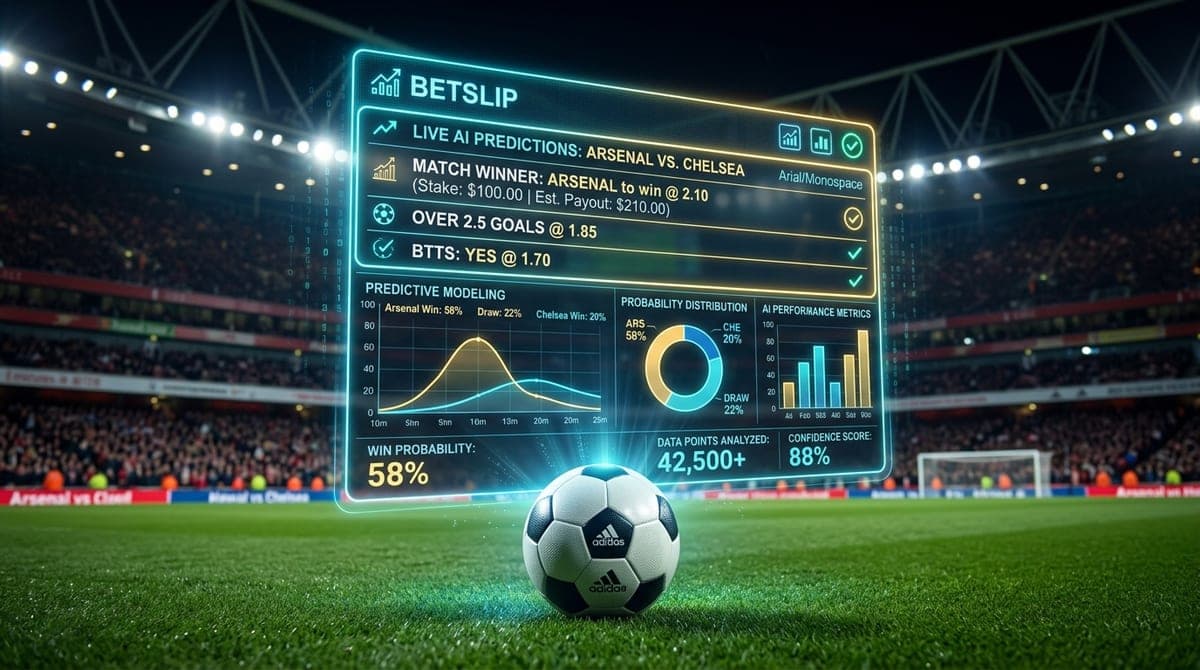
At their core, AI betting predictors are sophisticated software platforms that use machine learning algorithms to analyze sports data and forecast the probability of various match outcomes. While a human bettor might look at the last five matches a team has played, an AI model can instantly process thousands of data points spanning decades.
These predictors don't just guess who will win or lose. They provide calculated probabilities for a wide range of betting markets, including:
- Match Winner (1X2): The likelihood of a home win, draw, or away win.
- Over/Under Goals: Predictions on the total number of goals scored in a match.
- Both Teams to Score (BTTS): The probability that both sides will find the back of the net.
- Player Props: Predictions on individual player performances, such as expected goals, shots on target, or even yellow cards.
By stripping away human bias and emotion, AI models offer a cold, calculated look at the numbers. If you want to dive deeper into the mechanics behind these models, check out our guide on Understanding Machine Learning in Sports.
How Do AI Betting Models Work?
To truly trust an AI betting predictor, you need to understand how it formulates its predictions. The process generally involves three distinct phases: Data Ingestion, Pattern Recognition, and Probability Output.
1. Data Ingestion
AI models are hungry for data. For a tournament like the FIFA World Cup, a high-quality AI tool will ingest data from a multitude of sources. This includes:
- Historical Match Data: Results from previous World Cups, qualifiers, and international friendlies.
- Player Statistics: Individual metrics like passing accuracy, sprint speed, expected goals (xG), and expected assists (xA).
- Situational Variables: Weather conditions, travel fatigue, altitude (a crucial factor for matches in cities like Mexico City), and referee tendencies.
- Sentiment Analysis: Some advanced models even scrape social media and news outlets to gauge squad harmony or injury rumors.
2. Pattern Recognition
Once the data is ingested, the machine learning algorithms take over. Using techniques like neural networks and regression analysis, the AI looks for hidden patterns that humans might miss. For example, the AI might discover that a specific South American team tends to underperform when playing at high altitudes after a short rest period against teams that play a low-block defensive system.
3. Probability Output
Finally, the AI synthesizes these patterns into actionable probabilities. Instead of simply saying "Team A will beat Team B," the AI will express its prediction as a percentage (e.g., Team A has a 62% chance of winning). Bettors can then compare the AI's probability against the odds offered by bookmakers to find value bets.
Top Features to Look for in an AI Predictor for FIFA 2026
Not all AI betting tools are created equal. As we approach the 2026 World Cup, the market will likely be flooded with platforms claiming to have the "ultimate winning algorithm." Here is what you should actually look for when choosing a tool:
- Transparent ROI Tracking: A reputable AI tool should clearly display its historical Return on Investment (ROI). If they hide their past losses, look elsewhere.
- Customizable Alerts: The ability to set notifications for when a value bet appears based on line movement.
- Real-Time Injury Integrations: The World Cup moves fast. An AI model is useless if it doesn't instantly update its predictions when a star player pulls a hamstring in training.
- User-Friendly Dashboard: You shouldn't need a degree in data science to understand the platform's insights.
- ✓ Unmatched FIFA dataset
- ✓ real-time injury and weather updates
- ✓ identifies value bets automatically
- ✗ Premium pricing
- ✗ steep learning curve for complete beginners
Step-by-Step Guide to Using AI Predictors for the World Cup
Ready to integrate AI into your betting strategy? Follow these steps to get started before the first whistle blows in 2026.
Step 1: Establish Your Baseline
Before looking at any AI predictions, familiarize yourself with the 48 teams. The 2026 format introduces 12 groups of four teams, meaning the dynamics of group stage progression will be different from previous tournaments. Understand the basic narratives, key players, and group permutations.
Step 2: Input Your Parameters
Log into your chosen AI predictor. Most platforms allow you to filter predictions by market. If you specialize in Over/Under bets, set the AI to highlight the matches with the highest probability discrepancy in goal markets.
Step 3: Hunt for Expected Value (+EV)
This is the most critical step. The goal of using an AI is not just to predict winners, but to find Expected Value (+EV).
Value exists when the probability of an outcome, as calculated by your AI, is greater than the probability implied by the bookmaker's odds. Example:
- The bookmaker offers odds of 2.00 (implied probability of 50%) for the USA to beat Wales.
- Your AI predictor calculates that the USA actually has a 60% chance of winning.
- Because the AI's probability (60%) is higher than the bookmaker's implied probability (50%), this is a value bet. Over the long run, consistently making value bets is the only mathematical way to ensure profitability.
Step 4: Cross-Reference with Human Context
AI is brilliant at crunching numbers, but it can lack nuance. Before placing a bet recommended by the AI, apply your human context. Does the AI know that a team has already qualified for the knockout stage and might rest their entire starting XI? Does it understand the intense geopolitical rivalry between two nations that might lead to a cagey, low-scoring affair? Use the AI as your foundation, but let human logic have the final say.
For more insights into balancing automation with human intuition, read our article on The Future of Predictive Analytics.
Advanced Strategies to Maximize AI Predictions
To truly capitalize on AI during the 2026 World Cup, you need to go beyond basic match-winner markets. Here are three advanced strategies to consider:
1. In-Play (Live) Betting with AI
The World Cup is highly volatile, and pre-match predictions can be thrown out the window within the first ten minutes due to a red card or an early goal. The best AI tools now offer live predictive engines that recalculate probabilities in real-time based on the flow of the game. Using AI for in-play betting allows you to capitalize on overreactions from the betting public. If a heavy favorite concedes an early goal against the run of play, the AI might identify that their probability of winning is still incredibly high, offering a lucrative live betting opportunity.
2. Exploiting Niche Markets
Bookmakers spend vast amounts of resources ensuring their odds for Match Winner and Over/Under Goals are incredibly tight. However, they spend far less time optimizing odds for niche markets like "Number of Corners," "Player to receive a Yellow Card," or "Total Throw-ins." AI models can easily process the data required for these prop bets, often uncovering massive value that the bookmakers have overlooked.
3. Hedging and Arbitrage
If you are using multiple AI tools or comparing AI predictions across dozens of different sportsbooks, you may find arbitrage opportunities. This occurs when you can bet on all possible outcomes of an event across different bookies and guarantee a profit regardless of the result. While rare in high-profile events like the World Cup, AI scrapers are the fastest way to identify these fleeting opportunities. For a broader look at automating income streams, check out How to Automate Your Side Hustle.
The Limitations of AI in Sports Betting
While AI is a revolutionary tool for sports bettors, it is not infallible. It is crucial to approach AI predictors with a realistic mindset and an understanding of their limitations.
The "Black Swan" Events: Machine learning relies on historical data to predict future outcomes. However, sports are inherently unpredictable, and football is famous for its "Black Swan" events—unprecedented occurrences that defy all logic. Think of Saudi Arabia beating Argentina in 2022. No AI model could have confidently predicted that outcome because there was no historical precedent for it.
Garbage In, Garbage Out: An AI model is only as good as the data it is fed. If an AI predictor uses outdated statistics or fails to account for a sudden managerial change, its predictions will be flawed. Always ensure you are using a premium tool that utilizes real-time, high-fidelity data APIs.
The Edge is Shrinking: As AI tools become more accessible to the general public, the betting syndicates and the bookmakers themselves are also using vastly superior AI models to set their odds. The "edge" you get from using a consumer-grade AI predictor is shrinking. To stay ahead, bettors must focus on niche markets and perfect their bankroll management.
Bankroll Management: The Unsexy Secret to Success
You can have the most advanced, expensive AI predictive model on the planet, but if you do not practice strict bankroll management, you will eventually lose your money. The World Cup is a marathon, not a sprint.
- The Unit System: Divide your total bankroll into units (usually 1% to 2% of your total bankroll). Never bet more than 1-2 units on a single AI prediction, no matter how confident the model is.
- Embrace Variance: AI models predict probabilities, not certainties. Even a bet with a 90% probability of winning will lose 1 out of 10 times. You must have a bankroll large enough to absorb these inevitable losses without going bust.
- Track Everything: Keep a meticulous spreadsheet of every bet you place based on AI recommendations. After the group stages, analyze your results. Is the AI highly accurate on European teams but struggling with the CONCACAF region? Adjust your strategy accordingly for the knockout rounds.
Conclusion
The FIFA World Cup 2026 is set to be a spectacular display of footballing talent, and for the savvy bettor, it represents an unparalleled opportunity. By incorporating AI betting predictors into your strategy, you are replacing emotion and guesswork with cold, hard data.
Remember, the goal is not to blindly follow an algorithm, but to use the AI's immense processing power to identify value that you would otherwise miss. Combine the mathematical rigor of machine learning with your own nuanced understanding of the game, practice strict bankroll management, and you'll be well-equipped to tackle the odds this summer.
As the tournament approaches, start testing different AI platforms during domestic league matches. Get comfortable with the interfaces and understand their strengths and weaknesses. By the time the first ball is kicked in North America, you'll have a data-driven strategy ready to go.
Disclaimer: Sports betting involves significant risk and is not suitable for everyone. Always gamble responsibly and only bet what you can afford to lose. The information provided in this article is for educational purposes only and does not constitute financial advice.
David tests AI tools, gadgets, and developer platforms hands-on before writing about them. His work focuses on making complex tech approachable — without the hype. He has covered 100+ products across AI, gadgets, and software for TechPixelly.