Ray Tracing Overdrive in GTA 6
TL;DR
Grand Theft Auto 6 (GTA 6) is highly anticipated not just for its gripping narrative and expansive open world, but for its groundbreaking technical leaps. Rumors heavily suggest Rockstar Games is implementing a "Ray Tracing Overdrive" mode, pushing path-traced global illumination, reflections, and shadows to unprecedented levels in a massive open-world setting. This post explores the deep technical implications of this technology for gameplay immersion, the severe hardware tax it demands on modern PCs, how Rockstar's RAGE engine is evolving, and how it compares to existing showcases like Cyberpunk 2077's own Overdrive mode.
The Evolution of Open-World Lighting
When we think back to the launch of Grand Theft Auto 5 in 2013, it was a technical marvel of its time. Rockstar Games managed to squeeze every ounce of performance out of the aging PS3 and Xbox 360 hardware to deliver a vibrant, believable Los Santos. But rendering and lighting tech has moved at lightspeed over the last decade. Rasterized lighting—baking shadows into textures, using screen-space reflections (SSR) for water and mirrors, and utilizing probe-based global illumination—has been the industry standard for a long time. However, as hardware has evolved, we've crossed the threshold into the realm of real-time ray tracing.
In recent years, games like Cyberpunk 2077, Alan Wake 2, and Portal RTX have shown us what full "Path Tracing" (often branded as an "Overdrive" mode) can do. Instead of using ray tracing merely as an additive effect for reflections or shadows in isolation, path tracing simulates the actual physical behavior of light rays bouncing off every single surface in the scene.
For a game as dynamic, unpredictable, and sprawling as GTA 6, implementing a full Ray Tracing Overdrive mode represents a monumental technical challenge—and a potentially industry-defining achievement that will set the standard for the next ten years.
The Rockstar Advanced Game Engine (RAGE): A Retrospective
To understand how GTA 6 might implement Ray Tracing Overdrive, we have to look at the engine powering it. The Rockstar Advanced Game Engine (RAGE) has been the backbone of Rockstar's titles since Rockstar Games Presents Table Tennis back in 2006. Over the years, RAGE has seen massive iterative upgrades.
With Red Dead Redemption 2 (RDR2) in 2018, RAGE showcased some of the most impressive rasterized lighting, volumetric fog, and weather systems ever seen in a video game. RDR2's lighting was heavily reliant on highly advanced probe-based global illumination and physically based rendering (PBR) materials.
However, RDR2 did not feature hardware-accelerated ray tracing. Moving from RDR2's highly optimized rasterized pipeline to a fully path-traced pipeline for GTA 6 means rewriting core rendering paradigms. The engine must transition from "faking" light to simulating it computationally. This means managing Bounding Volume Hierarchies (BVH)—the data structures used to calculate ray intersections—in a world filled with thousands of moving pedestrians, dynamic vehicles, and cascading physics explosions.
What is Ray Tracing Overdrive? (Path Tracing vs. Standard RT)
To truly appreciate the "Overdrive" moniker, we need to distinguish between standard Ray Tracing and Path Tracing.
- Standard RT (Hybrid Rendering): This approach uses traditional rasterization to render the base image, then applies ray tracing selectively for specific visual effects like reflections, ambient occlusion, or shadows. It's a compromise designed to offer a visual bump without completely destroying frame rates.
- Path Tracing (Overdrive): This replaces almost the entire traditional lighting pipeline. It shoots millions of rays from the player's camera into the virtual scene, calculating how they bounce, absorb, refract, and scatter based on the physical properties of the materials they hit. It is computationally astronomical, unifying shadows, reflections, and global illumination into a single, cohesive physics simulation.
If Rockstar achieves full path tracing in a world as dense and physics-heavy as the new Vice City, it will be the absolute benchmark for PC hardware testing, much like Crysis was in 2007.
Why GTA 6 Needs Path Tracing
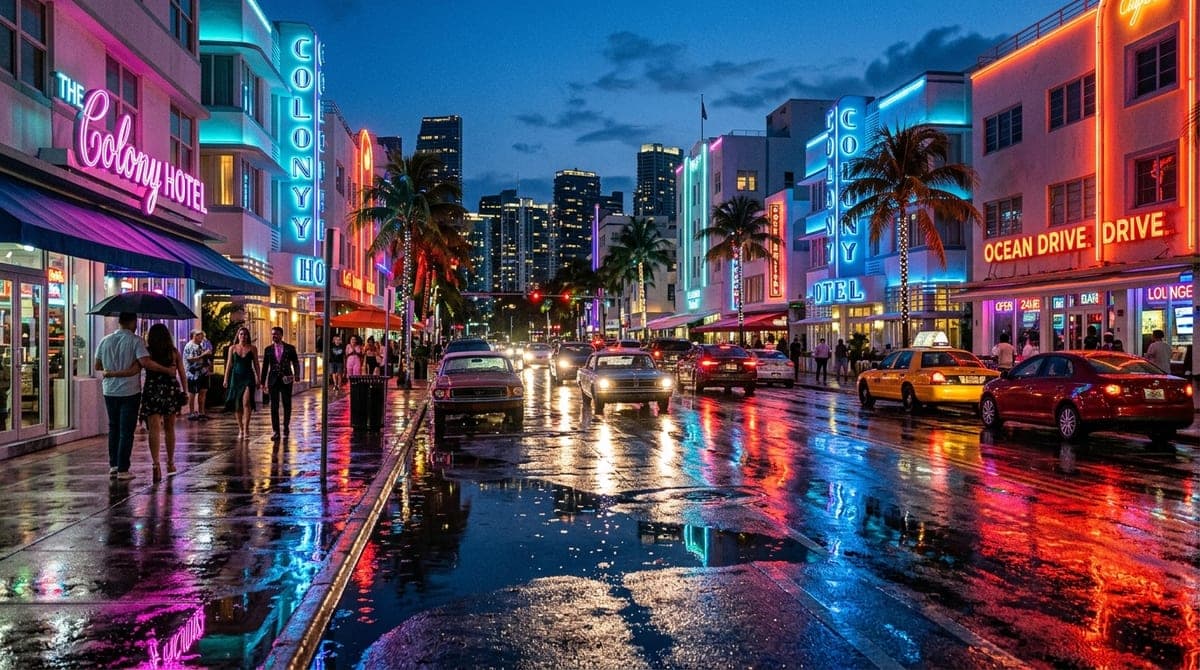
In the context of the Leonida state (the confirmed setting for GTA 6, heavily inspired by Florida), lighting isn't just decoration; it's the core of the aesthetic. Vice City is defined by its neon-soaked nightlife, glaring tropical sun, and sudden torrential downpours.
Imagine cruising down Ocean Beach at midnight. With standard rasterization, the neon signs might reflect on the wet pavement using Screen-Space Reflections (SSR). But SSR has a fatal flaw: the reflections disappear the moment the light source leaves your screen space. If you look down at the puddle, the neon sign above you vanishes from the reflection.
With Ray Tracing Overdrive:
- Real-Time Global Illumination (RTGI): The intense pinks and cyan blues from storefront neon will physically bounce off the hoods of passing cars, realistically illuminate the faces of NPCs walking on the sidewalk, and cast soft, diffuse, colored shadows into nearby alleyways.
- Pixel-Perfect Reflections: Puddles, car mirrors, chrome bumpers, and the towering glass facades of downtown skyscrapers will reflect the world flawlessly, regardless of where the player's camera is looking.
- Dynamic, Multi-Source Shadows: Every single street lamp, car headlight, police siren, and muzzle flash will cast physically accurate shadows. A police helicopter's spotlight sweeping across a chaotic nighttime chase will dramatically and realistically change the scene's entire lighting profile in real-time, casting harsh shadows that warp accurately across the geometry of the street.
For more insights into how modern game engines are handling these massive lighting calculations, check out our deep dive into Unreal Engine 5.5's Lumen technology.
The Hardware Tax: Can Your Rig Run It?
Let's address the elephant in the room. Path tracing is brutal on graphics cards. Cyberpunk 2077's RT Overdrive mode can bring even an RTX 4090 to its knees if not for AI upscaling magic.
For GTA 6's theoretical Overdrive mode, PC players will need the absolute bleeding edge of hardware. We are talking about the upcoming Nvidia RTX 50-series (like the rumored RTX 5090) or the top-tier RTX 40-series cards. But it's not just about raw GPU horsepower; the CPU and memory architecture will be pushed to their limits.
CPU Bottlenecks and BVH Building
In an open-world game, the CPU is responsible for keeping track of every NPC, vehicle, and physics object. To ray trace those objects, the CPU must constantly update the BVH structures and send them to the GPU. If you cause a 30-car pileup on the highway, the BVH structure for that entire cluster of warped metal and flying debris must be recalculated instantly. A highly capable multi-core CPU (like AMD's X3D series) will be strictly necessary to avoid massive frame drops during chaotic moments.
VRAM Requirements
Storing the high-resolution textures, complex geometry, and immense lighting data for a seamless open world requires massive amounts of Video RAM (VRAM). It is highly likely that 16GB of VRAM will be the bare minimum for enabling high-end ray tracing features, with 24GB GPUs becoming the standard for playing the game on "Overdrive" at 4K resolution.
If you are looking to upgrade your rig in preparation for the next generation of massive open-world titles, you'll need a serious powerhouse GPU that can handle path tracing.
- ✓ Unmatched ray tracing performance
- ✓ 24GB VRAM handles massive open worlds easily
- ✓ full DLSS 3.5 support.
- ✗ Extremely expensive
- ✗ massive physical footprint requires a large PC case.
The Role of AI: DLSS, Frame Generation, and Ray Reconstruction
Rockstar Games will almost certainly rely heavily on AI upscaling and frame generation technologies to make Ray Tracing Overdrive playable at acceptable framerates. Nvidia's DLSS (Deep Learning Super Sampling) and AMD's FSR (FidelityFX Super Resolution) will not just be optional settings; they will be mandatory.
- Frame Generation: This technology uses AI to analyze sequential frames and motion vectors, inserting entirely new, AI-generated frames between the natively rendered ones. This will be the saving grace for maintaining 60 FPS or higher with Overdrive turned on.
- Ray Reconstruction (DLSS 3.5+): In path-traced games, a standard denoiser often smears details or causes "ghosting" on moving objects. AI-powered Ray Reconstruction replaces traditional hand-tuned denoisers with an AI network trained to recognize lighting patterns, resulting in significantly sharper reflections and faster lighting response times. For a fast-paced game like GTA, Ray Reconstruction will be vital.
The Water and Weather of Leonida
The fictional state of Leonida is heavily defined by its coastal environments, wetlands, and tropical weather. Water rendering and weather systems are areas where Ray Tracing Overdrive will truly flex its muscles.
Ocean Dynamics and Swamps
Rasterized water often struggles with accurate light scattering, depth calculation, and transparency. With path tracing, sunlight will physically penetrate the ocean surface, refracting based on the depth, clarity, and turbulence of the water, creating hyper-realistic ray-traced caustics on the ocean floor. In the muddy, dense swamps of Leonida, thick canopies of trees will create incredibly complex, overlapping shadow maps. God rays (volumetric lighting) will pierce through the thick morning fog with perfect physical accuracy, bouncing off the murky water.
Volumetric Clouds and Tropical Storms
GTA has always featured dynamic weather systems, but Ray Tracing Overdrive can take it much further. When a heavy tropical storm rolls in off the coast, the volumetric clouds won't just be a visual skybox—they will physically block and scatter the directional light from the sun, plunging the city into accurate, moody darkness. Lightning strikes won't just flash the player's screen white; they will act as intense, momentary point lights that cast stark, hyper-accurate shadows across the entire landscape for a fraction of a second.
If you're fascinated by how virtual ecosystems and weather systems are evolving in gaming, you might enjoy our article on The Future of Procedural Weather in RPGs.
Impact on Gameplay and Immersion
It's important to remember that graphics aren't just about making a game look pretty; they actively affect how a game feels to play. In a game that will likely feature stealth mechanics, high-speed driving, and chaotic shootouts, accurate lighting plays a deeply functional role.
- Stealth in the Shadows: True path-traced shadows mean that if you're crouching in a dark alley to hide from the LCPD, you are actually in the physical dark. NPCs' vision cones can be tied to the physical lighting of the scene rather than arbitrary, developer-placed "stealth zones."
- Nighttime Driving: Cruising the neon-lit highways of Vice City at 150 mph will be a visceral, terrifyingly realistic experience. The blinding headlights of oncoming traffic, the glow of your car's digital dashboard reflecting on the interior windshield, and the streetlights slicking off the wet asphalt will create a level of immersion previously reserved for pre-rendered CGI movies.
- Interior-to-Exterior Transitions: In older games, walking from a dark interior out into the bright midday sun often involved a fake "eye adjustment" post-processing filter. With RTGI, the sunlight spilling into a doorway is calculated accurately, making transitions between indoor and outdoor spaces entirely seamless and physically realistic.
Modding, FiveM, and the Future of GTA Roleplay
We can't talk about the PC version of a GTA game without mentioning the modding community. Platforms like FiveM have kept GTA 5 at the top of the Twitch charts for years through highly customized Roleplay (RP) servers.
If GTA 6 ships with a Ray Tracing Overdrive mode, the implications for the modding scene are massive. Modders will immediately start tweaking the ray tracing parameters, creating ultra-realistic graphics mods that push the RAGE engine even further. Imagine jumping into a heavily modded Vice City RP server where the lighting is so realistic that it genuinely feels like a live-action bodycam video.
However, server hosts will have to balance these incredible graphics with the performance needs of their player base. Path tracing in a multiplayer environment filled with 100+ custom player models and imported vehicles will be the ultimate stress test for any PC.
We discussed similar open-world rendering hurdles in our breakdown of Why AAA Development Takes So Long.
Conclusion: A Glimpse into the Future
The persistent rumors of a "Ray Tracing Overdrive" mode in Grand Theft Auto 6 are far more than just typical pre-release hype; they represent the next great leap in interactive entertainment. If Rockstar Games manages to pull off fully path-traced lighting in a world as dynamic, populated, and expansive as Leonida, they won't just be releasing a game—they will be establishing the ultimate benchmark for the next decade of PC hardware and rendering technology.
While console players on the PS5 and Xbox Series X will undoubtedly receive a stunning, highly optimized experience (likely utilizing standard, hybrid ray tracing), the true, uncompromised potential of the RAGE engine will be unlocked by those willing to invest in the bleeding edge of PC graphics. As we inch closer to the highly anticipated release, the technical community waits with bated breath to see just how deep the rabbit hole goes.
What do you think? Are you planning a massive, expensive PC upgrade to experience GTA 6 in all its path-traced glory, or are you perfectly happy playing it on a standard console? Let us know on Twitter/X or join the discussion in our community Discord!
David tests AI tools, gadgets, and developer platforms hands-on before writing about them. His work focuses on making complex tech approachable — without the hype. He has covered 100+ products across AI, gadgets, and software for TechPixelly.