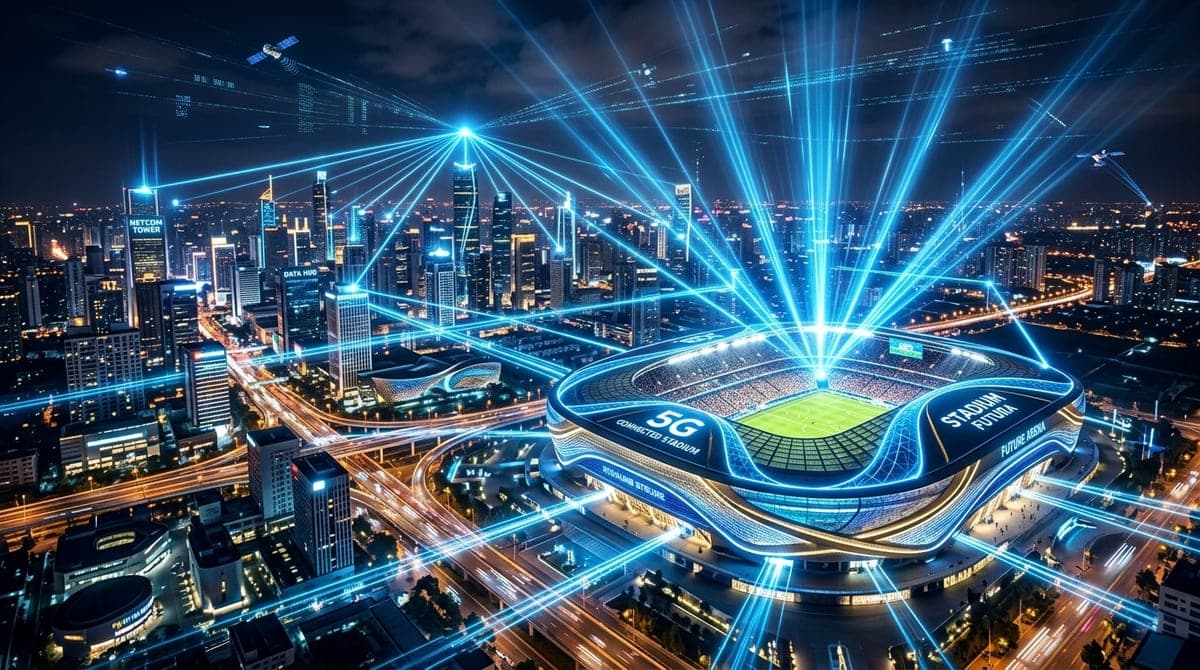
5G and Smart Stadiums for the 2026 World Cup
TL;DR
- Unprecedented Connectivity: 5G networks will finally eliminate the dreaded "dead zones" in packed stadiums, offering multi-gigabit speeds to over 80,000 fans simultaneously.
- Immersive AR Experiences: Augmented Reality will allow fans to view real-time player stats, ball trajectories, and multi-angle instant replays directly from their smartphones.
- Frictionless Operations: IoT sensors and edge computing will power cashier-less concessions, smart parking, and predictive crowd management for a seamless game-day experience.
- Broadcasting Evolution: 8K streaming, volumetric video, and drone cameras will leverage 5G's ultra-low latency to deliver a revolutionary viewing experience for fans around the world.
The FIFA World Cup has always been a global spectacle, a month-long celebration of the beautiful game that captivates billions. But as we look ahead to the 2026 World Cup—jointly hosted by the United States, Canada, and Mexico—the excitement isn't just about the expanded 48-team format. It’s about a massive technological leap. The 2026 tournament is poised to be the most technologically advanced sporting event in human history, acting as a global coming-out party for the true capabilities of 5G and smart stadium infrastructure.
For decades, the live sports experience has been a double-edged sword. On one hand, there is the undeniable thrill of being in the stands, surrounded by roaring fans. On the other, there are the logistical nightmares: agonizingly long lines for overpriced food, chaotic parking, and the universal frustration of looking at your smartphone only to see "No Service" despite having full bars.
But the stadiums of 2026 are being built—or retrofitted—to change all of this. By weaving hyper-fast, high-capacity 5G networks together with the Internet of Things (IoT) and edge computing, these venues are transforming from massive concrete bowls into intelligent, interactive hubs.
In this deep dive, we'll explore exactly how 5G and smart technologies are going to redefine what it means to attend a World Cup match. If you want to brush up on related networking advancements, check out our guide on The Future of Edge Computing and IoT and our breakdown of Wi-Fi 7 vs 5G in Public Spaces.
The Evolution of the Smart Stadium
The concept of a "smart stadium" isn't entirely new. Over the last decade, we've seen venues install high-density Wi-Fi and create bespoke stadium apps. However, these early iterations were fundamentally limited by the technology of the time. Wi-Fi networks, even enterprise-grade ones, struggle when 80,000 people simultaneously try to upload a video of a penalty kick to Instagram. 4G LTE, while revolutionary for mobile broadband, simply lacks the bandwidth and low latency required for massive, dense crowds.
Enter 5G.
Fifth-generation mobile networks represent a paradigm shift. Utilizing high-frequency millimeter-wave (mmWave) bands and mid-band spectrum, 5G can handle exponentially more connected devices per square kilometer than 4G. It offers speeds that rival or exceed fiber-optic home internet, with latency (the time it takes for data to travel from the device to the server and back) dropping from 40-50 milliseconds to the single digits.
This isn't just about faster downloads; it's about enabling a completely new class of real-time, data-heavy applications that were previously impossible in a crowded environment.
The Fan Experience: Augmented Reality and Real-Time Data
The most noticeable impact of 5G at the 2026 World Cup will be in the palm of your hand. For years, sports fans have jokingly complained that the view from the couch at home—with its multiple camera angles, instant replays, and overlaid graphics—is actually better than the view from the stands. 5G aims to bring the best of the broadcast experience directly to the live fan.
Augmented Reality (AR) Overlays
Imagine pointing your phone's camera at the pitch. Through an AR app powered by 5G's massive bandwidth and low latency, you aren't just seeing the players; you are seeing their real-time statistics hovering above their heads. You can see how fast a player is sprinting, their heat map for the match, and their pass completion rate.
If a contentious offside call is made, you won't have to wait for the stadium screens to show a replay. You'll be able to pull up an interactive, 3D render of the play on your device, rotating the angle to see exactly what the VAR (Video Assistant Referee) is seeing. This level of immersion relies heavily on edge computing, where data is processed locally at the stadium rather than sent to a distant cloud server, ensuring there is zero lag between the live action and the digital overlay.
Multi-Angle Streaming in Your Seat
In 2026, stadiums will be outfitted with dozens of high-definition, 5G-connected micro-cameras. Fans will have the ability to open the official World Cup app and select which camera feed they want to watch in real-time. Want to watch the match exclusively from the perspective of the goalkeeper? Or from a spider-cam hovering above the midfield? 5G makes streaming these multiple high-bitrate video feeds to tens of thousands of simultaneous users possible.
If you are planning to attend the 2026 games and want to make sure your device can handle these massive data streams, you might be in the market for an upgrade.
- ✓ Incredible mmWave 5G performance
- ✓ unmatched zoom cameras for stadiums
- ✓ brilliant anti-reflective display.
- ✗ Premium price tag
- ✗ large form factor.
Frictionless Operations: Concessions, Merch, and Restrooms
The "smart" in smart stadiums isn't just about flashy AR graphics; it's deeply integrated into the operational logistics of the venue. The goal is to eliminate friction—the points in the fan journey that cause frustration and delays.
Cashier-less Concessions
We've already seen the debut of "just walk out" technology in retail stores, spearheaded by Amazon Go. By 2026, this will be standard in World Cup stadiums. Powered by computer vision, weight sensors, and high-speed 5G connectivity, fans will be able to scan their app, grab a beer and a hot dog, and walk straight back to their seats. The system will automatically charge their digital wallet.
For stadium operators, this does more than just make fans happy; it drastically increases throughput. During a 15-minute halftime break, the ability to serve thousands of fans without the bottleneck of traditional point-of-sale transactions translates to a massive increase in revenue.
Smart Restrooms and Crowd Flow
IoT sensors connected via 5G will monitor everything from soap dispenser levels to the length of lines outside restrooms. The stadium app will be able to guide fans to the nearest restroom with the shortest wait time.
Similarly, predictive crowd management systems will analyze real-time movement data to prevent bottlenecks. If sensors detect a dangerous buildup of people at a specific gate, automated systems can redirect digital signage to route incoming fans to alternative entrances, enhancing both efficiency and safety. (Read more about The Evolution of IoT in Urban Planning to see how this technology scales to entire cities).
Security and Safety in a Hyper-Connected Environment
Hosting a World Cup involves securing venues that hold up to 100,000 people, including dignitaries, athletes, and fans from all over the globe. Security is paramount, and 5G will provide law enforcement and security personnel with unprecedented tools.
Facial Recognition and Biometrics
While privacy concerns remain a valid discussion point, the reality of modern mega-events is that biometric security will play a major role. 5G's massive uplink capacity allows for high-definition facial recognition cameras to stream data in real-time to security databases. This allows for frictionless, ticketless entry for fans who opt-in, as well as the rapid identification of known security threats or banned individuals before they even reach the gates.
AI-Powered Threat Detection
Security cameras aren't just recording; they are analyzing. AI algorithms running on edge servers will continuously monitor video feeds for anomalies. This could be an unattended backpack, a sudden crowd stampede, or even the detection of drones flying in restricted airspace above the stadium. 5G allows this data processing to happen in milliseconds, providing security teams with instant alerts and real-time situational awareness.
Broadcasting the Beautiful Game: A New Era for Media
The impact of 5G isn't limited to the people inside the stadium. It completely changes how the event is broadcasted to the billions watching worldwide.
Traditionally, broadcasting a major sporting event requires miles of physical cabling, massive broadcast trucks outside the stadium, and days of setup. 5G introduces the era of "wireless broadcasting."
5G-Enabled Drones and Wearables
With 5G, a broadcast camera no longer needs to be tethered to a cable. Broadcasters can deploy highly agile 5G drones to capture sweeping, cinematic shots of the stadium and the surrounding city, streaming 4K or even 8K footage directly to the production team with virtually no latency.
Furthermore, we are seeing the introduction of wearable cameras. Referees equipped with tiny 5G-connected body cams can provide viewers at home with a stunning first-person perspective of the action.
Volumetric Video and Holograms
Looking slightly further into the future, 5G is the missing link for volumetric video—capturing the match in true 3D space. By placing dozens of high-speed cameras around the pitch, the game can be digitized into a 3D environment. For fans at home with VR headsets, this means they could potentially "step onto the pitch" and view a goal from exactly where the striker was standing.
The Challenges of Deploying 5G at Scale
While the vision of the 2026 smart stadium is breathtaking, getting there is not without significant challenges.
- Infrastructure Costs: Wiring a massive stadium for mmWave 5G is incredibly expensive. mmWave signals are easily blocked by physical barriers (and even human bodies), meaning stadiums require hundreds, if not thousands, of small cell antennas strategically placed under seats, in corridors, and along the rooflines.
- Device Compatibility: While 5G adoption is growing rapidly, not every fan traveling from across the globe in 2026 will have a fully compatible mmWave 5G device. Stadiums will still need to support legacy 4G LTE and robust Wi-Fi networks as fallbacks, complicating the network architecture.
- Data Privacy and Cybersecurity: With everything from ticket data and location tracking to biometrics and payment info flowing through the stadium's network, the cybersecurity attack surface is massive. Hardening these networks against potential state-sponsored or independent cyberattacks is a monumental task.
Conclusion: The Ultimate Test for Next-Gen Tech
The 2026 World Cup in North America is shaping up to be much more than a football tournament. It will serve as a global showcase for the maturation of 5G, edge computing, and IoT.
When fans step into the Azteca Stadium in Mexico City, AT&T Stadium in Dallas, or BMO Field in Toronto, they won't just be entering a sports venue; they will be stepping into highly orchestrated, intelligent environments designed to cater to their every need. The days of disconnected, frustrating stadium experiences are coming to an end.
The integration of 5G and smart stadium technology promises to bring the digital and physical worlds together, creating an immersive, seamless, and unforgettable experience that is fitting for the biggest sporting event on the planet. The beautiful game is about to get a massive technological upgrade, and we can't wait for kickoff.
What features are you most excited to see in the smart stadiums of 2026? Let us know in the comments below, and don't forget to check out our deep dive into The Impact of AI on Sports Analytics to see how the game itself is changing behind the scenes.
David tests AI tools, gadgets, and developer platforms hands-on before writing about them. His work focuses on making complex tech approachable — without the hype. He has covered 100+ products across AI, gadgets, and software for TechPixelly.