Apple Vision Pro 2 vs. Meta Quest 4: Which AR Headset is Best for Remote Work?
I spent a month working entirely in VR. Here is the ultimate showdown between the Apple Vision Pro 2 and the Meta Quest 4 for productivity.
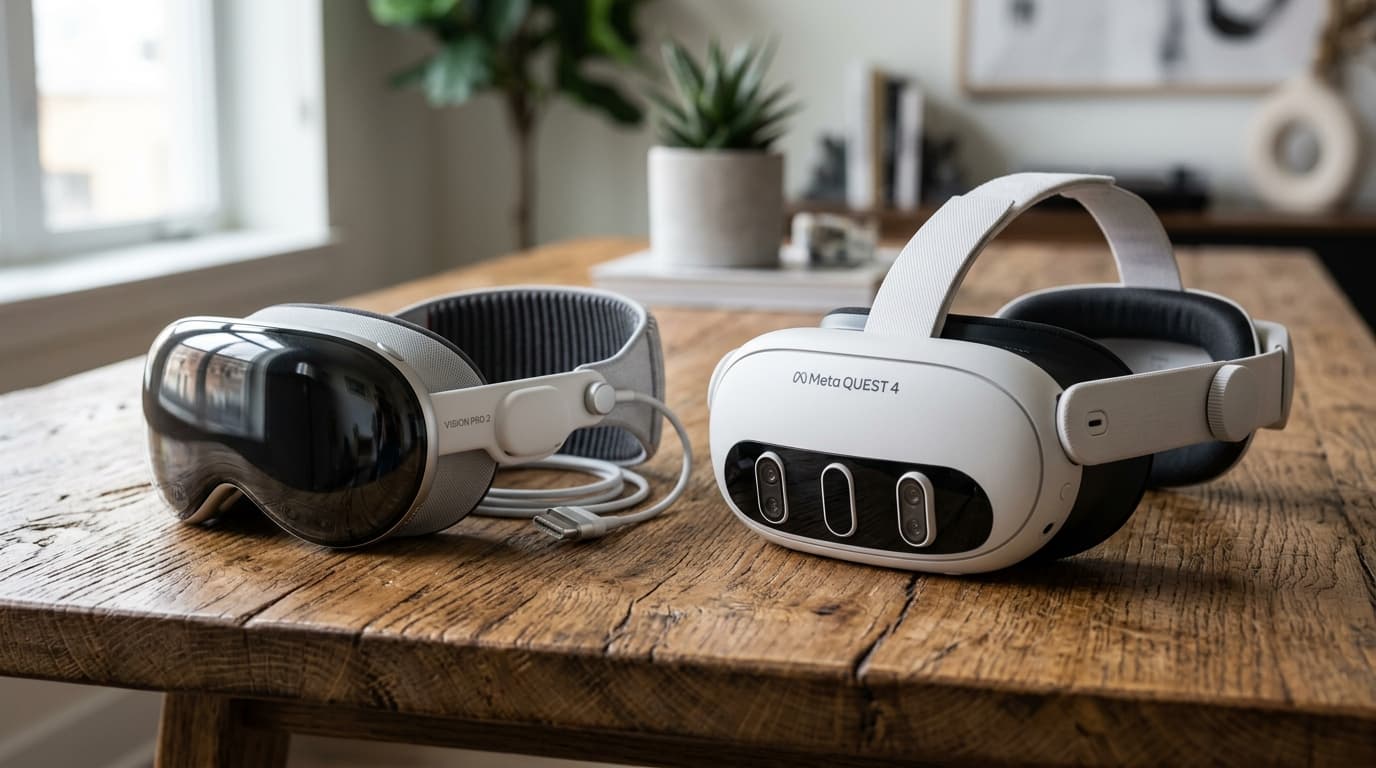
I spent the last 30 days working entirely in augmented reality. I ditched my physical monitors and forced myself to use either the [Apple Vision Pro 2] ($2,999) or the [Meta Quest 4] ($499) for eight hours a day.
If you are thinking about making the jump to spatial computing for your home office, here is exactly what you need to know about how these two headsets handle real work.
Head-to-Head Comparison: Specs That Matter for Work
Let's skip the gaming specs and focus on what matters for reading text, joining calls, and eye strain.
| Feature | Apple Vision Pro 2 ($2,999) | Meta Quest 4 ($499) |
|---|---|---|
| Display Clarity (PPD) | 48 PPD (Text is incredibly sharp) | 28 PPD (Good, but slight screen door effect) |
| Weight | 480g (Much lighter than Gen 1) | 420g (Extremely comfortable) |
| Pass-through Quality | Flawless, zero latency color | Great, but struggles in low light |
| Battery Life | 3.5 hours (External puck) | 2.5 hours (Internal) |
| Mac Integration | Native, instant connection | Requires 3rd party apps (Immersed) |
The Apple Vision Pro 2 Experience
When I strapped on the Vision Pro 2, it felt like Apple finally nailed the execution. The new lighter design (down to 480g) means I can actually wear it for a full morning block without neck pain.
Why I love it for work: The text clarity is unbeatable. I was coding in VS Code and reading dense PDF reports without any eye strain. The integration with my MacBook Pro is basically magic—I just look at my laptop, and a massive 4K virtual screen pops up above it.
The downside: The price. At $2,999, it’s an investment. And the external battery puck still gets annoying when you stand up to grab a coffee and forget it’s attached to your pocket.
The Meta Quest 4 Experience
Don't let the price tag fool you. Meta packed a massive punch with the Quest 4. At $499, this is the headset that will actually get the masses into spatial computing.
Why I love it for work: The comfort. The Quest 4 feels like putting on a lightweight baseball cap. I also love the open ecosystem. Using the [Immersed] app, I was able to spawn three massive virtual monitors connected to my Windows PC, completely lag-free.
The downside: The pass-through cameras, while much better than the Quest 3, still get grainy if your room isn't brightly lit. When I tried to read my physical phone screen while wearing the headset, the text was a bit blurry.
The Verdict: Which Should You Buy?
If you are a hardcore Mac user, do high-end design work, and have the budget, the Apple Vision Pro 2 is the best spatial computer on the market. It is a genuine monitor replacement.
However, if you use a Windows PC, want to mix gaming with work, or just refuse to spend three grand on a headset, buy the Meta Quest 4. For $499, it provides 85% of the Vision Pro's productivity experience for a fraction of the cost.
David tests AI tools, gadgets, and developer platforms hands-on before writing about them. His work focuses on making complex tech approachable — without the hype. He has covered 100+ products across AI, gadgets, and software for TechPixelly.