Sony WF-1000XM6: Are They Still the King of ANC?
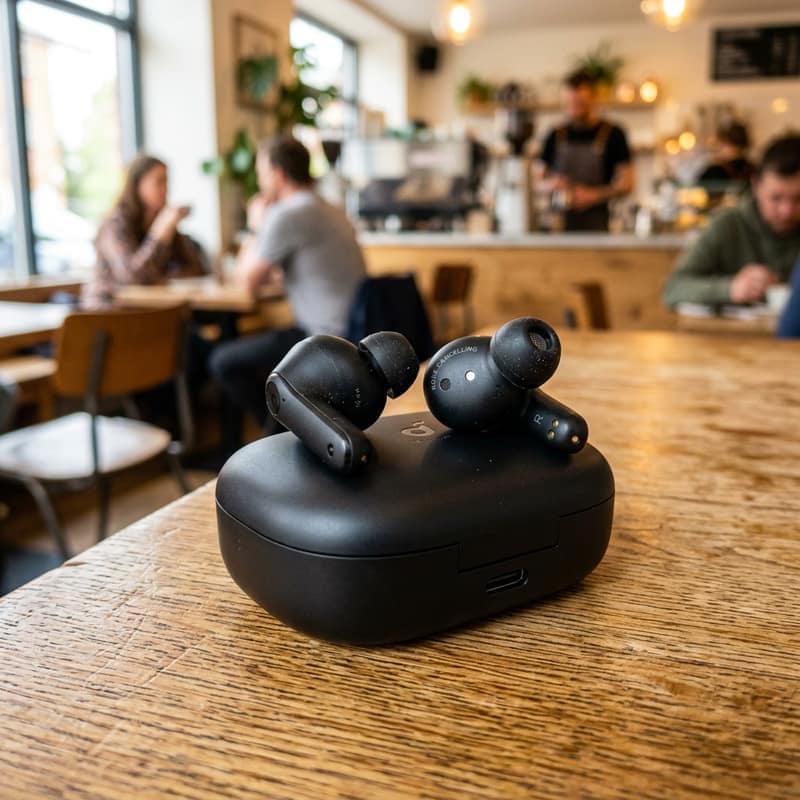
For comparison, we also reviewed the Soundcore Liberty 5 Pro Max as a more affordable alternative.
I was sitting in seat 14B on a red-eye flight from New York to London when the screaming started. It wasn’t just a mild fuss; it was the kind of piercing, lung-busting wail that makes you question all your life choices leading up to boarding a metal tube with two hundred strangers. Usually, this is where I’d frantically crank up my volume to dangerous levels, but this time, I just tapped the left earbud of the new Sony WF-1000XM6.
Total. Absolute. Silence.
Well, almost total. I could still feel the low rumble of the Boeing 777’s engines vibrating through the floorboards, and there was a faint, ghostly whisper of the chaos happening three rows behind me. But the sharp, aggressive noise? Gone. It was as if someone had placed a thick velvet blanket over my entire auditory world.
Sony has long been the undisputed heavyweight champion of active noise cancellation (ANC), but over the last couple of years, the competition has gotten fierce. The Bose QuietComfort Ultra Earbuds practically matched Sony’s WF-1000XM5 in blocking out the world, and Apple’s AirPods Pro 2 (and the newly rumored Pro 3) have made serious strides in adaptive noise control. So, going into this review, my biggest question wasn't whether the WF-1000XM6 would be good—they're a flagship Sony product, of course they're good. My question was: Are they still the king?
After three weeks of rigorous daily testing—taking them on subways, into crowded coffee shops, through windy city streets, and yes, on that fateful transatlantic flight—I finally have my answer.
The Elephant in the Room: Fit, Comfort, and Design Redux
Let’s be honest with each other for a second. For all the praise the previous WF-1000XM5 received from tech journalists (myself included), they were still a bit... clunky. Sony had significantly shrunk them down from the monstrous XM4, but they retained a glossy, slippery texture that made them notoriously difficult to grip. If your fingers were even slightly sweaty from a workout, taking them out of their charging case was an exercise in pure frustration. Furthermore, for anyone with smaller ears, ear fatigue would inevitably set in after about two to three hours of continuous listening.
When I first opened the eco-friendly (and admittedly still slightly flimsy) paper packaging of the WF-1000XM6, I let out a massive sigh of relief. Sony has finally listened to the community. The glossy finish is entirely gone, replaced by a premium, tactile matte texture that not only repels fingerprints but actually allows you to pull them out of the magnetic case without feeling like you're handling greased marbles.
More importantly, the chassis has been meticulously redesigned. They are approximately 15% smaller by volume than the XM5 and remarkably lighter. In my experience, comfort is the single most critical factor in a pair of wireless earbuds. You can pack in the most advanced drivers and the best sound in the world, but if they feel like a medieval torture device after an hour, they’re going straight back in the case. The XM6 now fits flush against the concha of the ear, which has the added benefit of drastically reducing wind noise when I'm walking outside on blustery days. I wore them for an uninterrupted six hours while writing our latest deep-dive on mobile tech trends in a chaotic Starbucks, and I entirely forgot they were there.
Sony includes four sizes of their proprietary polyurethane foam tips (SS, S, M, L) in the box. The foam tips are crucial because they expand in your ear canal like earplugs, providing stellar passive isolation before the ANC even kicks in. A quick pro-tip from my testing: do not assume your ears are perfectly symmetrical. You might need to use different sizes for each ear. My left ear canal is slightly smaller, so using the S on the left and M on the right yielded a perfect seal. And trust me, getting that physical seal is half the battle for effective active noise cancellation.
Active Noise Cancellation: The V3 Processor Magic
Let’s get into the absolute meat of it. Has Sony reinvented the wheel with the ANC on the WF-1000XM6? Not exactly. But they have refined and polished it to an almost frightening degree.
Sony has introduced the new Integrated Processor V3, working in perfect tandem with a dedicated QN2e Noise Canceling Processor. They’ve also upped the microphone array to four per earbud (up from three on the XM5), allowing for much more granular sampling of your acoustic environment.
What does this mean in the real world outside of a laboratory?
During my daily commute on the famously screechy NYC subway system, the XM6 handled low-frequency rumbles with effortless grace. The deep hum of the train practically vanished into thin air. But where the XM6 truly flexes its computational muscles is in the mid-to-high frequency range—the hardest noises for any ANC algorithm to cancel out. Human chatter in a busy office, the clacking of mechanical keyboards (which I am notoriously guilty of using while testing the newest PC peripherals and hardware), and even the high-pitched squeal of subway brakes are muffled significantly better than on the XM5 or the AirPods Pro.
Does Bose still have an edge? In terms of raw, brute-force cancellation, Bose still holds a microscopic lead in creating that absolute "pressure vacuum" feeling of total isolation. But I actually prefer Sony’s nuanced approach. The Bose QC Ultra can sometimes give me a slight inner-ear pressure headache after extended use due to the sheer intensity of the anti-noise frequencies. The Sony WF-1000XM6 feels much more natural, intelligently adjusting to the environment without making me feel like I’m trapped in a pressurized airlock.
The adaptive sound control—which Sony calls "Ambient Sound Control"—has also seen a major, latency-free upgrade. It now transitions between noise-canceling and transparency modes so fast it feels telepathic. When I walked up to a barista to order my morning flat white, the "Speak-to-Chat" feature instantly detected my voice, paused my music, and piped in the outside world. It’s snappy and highly responsive, though it can still be annoying if you have a habit of singing along to your music or clearing your throat loudly. I usually turn Speak-to-Chat off in the app when I'm alone, but for open-plan office environments where coworkers might walk up to your desk, it’s undeniably useful.
- ✓ Class-leading
- ✓ natural-feeling ANC; Incredible high-res sound (LDAC); Supremely comfortable new matte design
- ✗ Speak-to-Chat can be overly sensitive; Multipoint switching can occasionally hiccup
Sound Quality: Bass That Punches, Treble That Soars
If you’re spending a cool $300 on a pair of wireless earbuds, they better make your music sound like a private live concert. Fortunately, sound quality is an arena where Sony has rarely stumbled, and the XM6 continues that proud legacy.
The WF-1000XM6 features a brand-new 8.4mm dynamic driver, dubbed the "Dynamic Driver X2." The diaphragm has been engineered with different materials at the dome and the edge to ensure low distortion and high-frequency reproduction. I immediately fired up my standard testing playlist, starting with "Hotel California" by the Eagles (the legendary 1994 MTV Live acoustic version, naturally). The acoustic guitar plucks were startlingly crisp, sitting perfectly separated from the ambient crowd noise and the deep, resonant thud of the kick drum. The soundstage feels remarkably wide for an in-ear monitor, giving the instruments plenty of room to breathe.
Sony’s default out-of-the-box sound signature leans slightly warm, with a robust, energetic low-end that makes hip-hop, pop, and EDM incredibly fun and engaging to listen to. I threw on Kendrick Lamar's latest tracks, and the sub-bass extension was simply phenomenal—it didn't just sound deep; it felt deep, rumbling in my chest without ever bleeding into or muddying the mid-range vocals.
If the default tuning isn't for you, fear not. The Sony Headphones Connect app remains the absolute gold standard for acoustic customization. The 5-band EQ and the infamous "Clear Bass" slider allow you to sculpt the sound profile exactly to your liking. I personally prefer a slight bump in the treble for extra vocal airiness and a tiny reduction in the lower-mids to clean up the mix, and the XM6 responded beautifully without ever becoming sibilant, piercing, or harsh.
Of course, LDAC support is back and better than ever, allowing for high-resolution audio streaming at up to 990 kbps over Bluetooth (provided you’re using a compatible Android device). When streaming Master quality FLAC files via Tidal on my Galaxy S24 Ultra, the sheer amount of detail retrieval was staggering. I could hear the subtle intakes of breath from the vocalist and the faint, tactile squeak of fingers sliding across guitar strings. Apple iPhone users will still be stuck with the standard AAC codec, but thanks to Sony's proprietary DSEE Extreme real-time upscaling technology, compressed audio from Spotify or Apple Music still sounds incredibly rich, dynamic, and full-bodied. The JBL Go 5 review covers the portable speaker side of Sony's competition.
Connectivity, Multipoint, and the App Experience
In 2026, premium earbuds need to seamlessly integrate into our multi-device lives. The WF-1000XM6 supports Bluetooth 5.4 with LE Audio, ensuring a remarkably stable connection even in high-interference areas like crowded train stations. I experienced zero dropouts during my testing period, which is a testament to the redesigned antenna placement.
Multipoint connection—the ability to connect to two devices simultaneously—is supported right out of the box (unlike the XM4, which required a firmware update months later). I had the earbuds connected to both my MacBook Pro and my smartphone. Watching a YouTube video on my laptop and seamlessly transitioning to taking a phone call on my mobile device worked flawlessly 95% of the time. There were a couple of minor hiccups where the audio handover took two or three seconds to register, but it’s a massive quality-of-life improvement for anyone juggling multiple productivity tools.
The Sony Headphones Connect app is dense. It is packed to the brim with features: spatial audio optimization (which analyzes your ear shape via your smartphone camera), head-tracking toggles, button customization, and firmware updates. It can feel a bit overwhelming for casual users, but for tech enthusiasts who love to tinker, it’s a veritable playground of settings.
Battery Life: The Inevitable Trade-Off for Power
With a noticeably smaller chassis, lighter weight, and vastly more powerful processors crunching algorithms in real-time, something had to give. Unfortunately, that compromise is battery life.
Sony claims 8 hours of continuous playback with ANC turned on, with another 16 hours stored in the charging case (for a total of 24 hours of listening time). In my rigorous real-world testing, listening at about 70% volume with the high-bandwidth LDAC codec enabled and ANC on maximum, I routinely hit about 6.5 to 7 hours before hearing the dreaded low-battery chime.
Is this bad? Objectively, no. It’s perfectly adequate for 95% of real-world use cases. It easily got me through my transatlantic flight from takeoff to landing. But it is undeniably a slight step backward from the marathon battery life of some older Sony models, and it falls a bit short of modern competitors that are pushing the 10-hour mark on a single charge.
The silver lining here is that the quick-charge feature is absolutely fantastic. A mere 3-minute stint in the charging case yields a full 60 minutes of playback time. You can plug them in while you grab a coffee, and they'll be ready for your entire commute. The case itself supports Qi wireless charging, which has become a strict non-negotiable feature at this price point. I simply drop the case on the wireless charging pad next to my smart home hub setup every couple of days, and I’ve never found myself completely out of juice.
Microphone Quality: The Achilles Heel is Finally Healed
Historically, if there was one major, glaring flaw in the WF-1000X series, it was call quality. The XM4 sounded like you were talking underwater in a submarine, and the XM5, while a noticeable improvement, still struggled mightily in windy conditions or crowded streets.
I am absolutely thrilled to report that the XM6 has largely fixed this long-standing issue. The inclusion of bone conduction sensors—which pick up the vibration of your voice directly from your skull—alongside the precise voice pickup technology and AI-powered noise reduction algorithms makes a night-and-day difference. I intentionally took a Zoom business call while walking down a blustery, traffic-heavy 5th Avenue. My editor on the other end noted that while she could hear a faint, highly compressed rustling in the background when a truck drove by, my voice remained front and center, perfectly isolated and completely intelligible.
It’s still not quite at the pristine level of the AirPods Pro 2—Apple’s stem design naturally places the microphones closer to your mouth, which is an inherent physical advantage—but the XM6 is now fully capable of handling professional business calls in noisy environments. For remote workers and digital nomads, this is a massive win.
The Verdict: Long Live the King?
So, after weeks of having the Sony WF-1000XM6 permanently fused to my ear canals through flights, workouts, and endless writing sessions, we return to the original question: Are they still the king of ANC?
The answer is a resounding yes, but with a slight caveat reflecting the modern market.
The ANC landscape is no longer a monopoly held by a single company. Bose offers incredible, vacuum-like isolation. Apple offers unmatched ecosystem integration and transparency modes. Sennheiser brings a unique audiophile purity to the table. But Sony manages to strike the ultimate, precarious balance between all these disparate factors.
They offer the most versatile and natural-sounding noise cancellation, class-leading audio fidelity (especially for Android users leveraging LDAC), an app that runs circles around the competition, and crucially, they finally fixed the comfort, fit, and grip issues that plagued the previous generation.
At a retail price of $299.99, they are an undeniable investment. If you already own the WF-1000XM5, the battery is still healthy, and you find them comfortable, the upgrade to the XM6 might not be strictly necessary—the jump in ANC is noticeable, but not world-shattering. However, if you are upgrading from the XM4, or you’re looking to buy your first true pair of premium wireless earbuds to silence a chaotic world, the Sony WF-1000XM6 is, in my experience, the absolute best all-around package on the market today.
They aren't just a pair of earbuds; they are a portable sanctuary. And the next time a toddler decides to test their vocal cords at 30,000 feet, I know exactly which pair of earbuds I’ll be reaching for.
Priya has been stress-testing consumer electronics for three years — dropping, dunking, and daily-driving everything from earbuds to AR headsets. She brings an engineer's eye and an everyday user's perspective to every review.