Rise of Agentic AI: How Autonomous AI Agents Are Transforming Workflows

Quick Summary
Agentic AI refers to AI systems that don't just respond to prompts—they plan, reason, and take action across multi-step workflows with minimal human supervision. In 2026, these autonomous agents are no longer a sci-fi concept. They're shipping code, managing customer pipelines, orchestrating research tasks, and running entire business processes end-to-end. This post breaks down what agentic AI really means, which platforms are leading the charge, and how you can start integrating autonomous agents into your own workflows today.
What Is Agentic AI, Really?
Let's cut through the buzzword soup. You've probably heard "AI agent" thrown around in every product launch for the past two years, but the definition has historically been muddy.
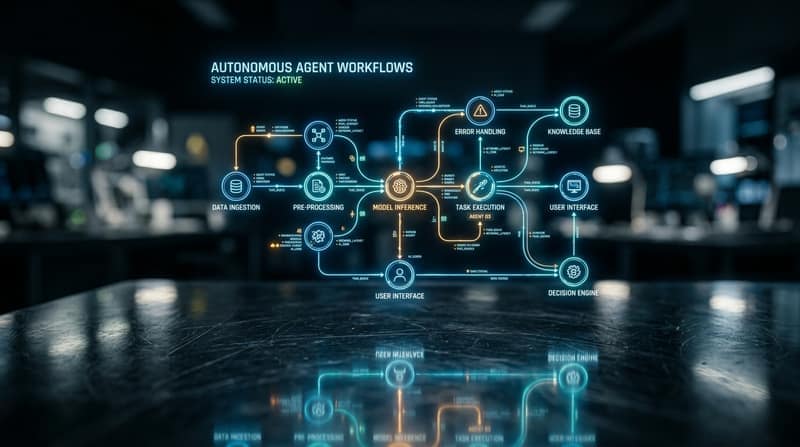
At its core, agentic AI describes an AI system that can:
- Perceive a goal or environment (inputs like files, emails, databases, APIs)
- Plan a series of steps to achieve that goal
- Execute those steps using tools—browsers, code interpreters, APIs, other AI models
- Self-correct when something doesn't go as expected
- Iterate until the task is complete
This is fundamentally different from a vanilla chatbot or even a sophisticated LLM like GPT-4o or Claude 3.5. Those models respond. Agents act.
The distinction matters enormously in practice. When you ask ChatGPT to draft a cold email, you get a draft. When you give an agentic system the same goal, it might research the prospect, pull their LinkedIn data, cross-reference your CRM, write the email, personalize it, and schedule the send—all without you lifting a finger after the initial prompt.
Why 2026 Is the Inflection Point
We've been talking about autonomous agents for years. So why is 2026 feeling different?
1. Models Got Good Enough
The reasoning capabilities of frontier models crossed a critical threshold. Multi-step planning—the Achilles' heel of earlier agentic systems—became dramatically more reliable with models like GPT-4.5, Claude 3.7 Sonnet, and Gemini 2.5 Pro. These models can hold complex task graphs in context, recover from errors mid-execution, and determine when they need to pause and ask for human input versus when they can proceed autonomously.
2. Tool Use Matured
Early agent frameworks were brittle. Tools would fail silently, APIs would return unexpected formats, and the whole pipeline would collapse. Today, standardized protocols like Anthropic's Model Context Protocol (MCP) and OpenAI's tool-calling spec have made integrating external tools dramatically more reliable. Agents can now talk to databases, browsers, APIs, and each other with far greater consistency.
3. Orchestration Frameworks Hit Production Maturity
Projects like LangGraph, AutoGen, CrewAI, and OpenAI's Assistants API have moved from experimental to enterprise-ready. Companies aren't duct-taping agents together in Jupyter notebooks anymore—they're deploying them in production with logging, observability, and human-in-the-loop checkpoints.
4. The Cost Equation Changed
Running a complex multi-agent workflow used to cost tens of dollars per execution—economically prohibitive for most use cases. With the introduction of smaller, faster, cheaper models (think GPT-4o-mini, Gemini Flash, Claude Haiku) for sub-tasks, the cost of a sophisticated agentic workflow has dropped by an order of magnitude.
Real-World Use Cases Already in Production
Software Development Pipelines
This is the most visible example of agentic AI in 2026. Tools like OpenAI Codex (now deeply integrated into enterprise GitHub workflows), Devin by Cognition, and Cursor's background agents can take a GitHub issue, spin up a development environment, write the code, run tests, fix failing cases, and open a pull request for human review.
Engineering teams aren't being replaced—but their leverage has expanded dramatically. A senior engineer managing a team of five can now effectively operate like a team of fifteen, with agents handling well-scoped, well-defined tasks autonomously.
Customer Support and Success
Agentic systems are powering the next generation of support workflows. Instead of a simple chatbot that deflects to FAQ articles, modern AI agents can:
- Look up the customer's account history in a CRM
- Check order status via an e-commerce API
- Issue refunds within pre-approved policy thresholds
- Escalate to human agents with full context when needed
- Follow up automatically with resolution surveys
Companies like Intercom (with their Fin AI Agent) and Salesforce (with Agentforce) are shipping these capabilities to enterprises at scale. The result: support costs drop while customer satisfaction goes up because issues actually get resolved, not just acknowledged.
Research and Competitive Intelligence
Marketers and strategists are deploying agents to run continuous competitive intelligence workflows. An agent can:
- Monitor competitor websites, press releases, and social channels
- Summarize changes and surface key insights daily
- Cross-reference with market data sources
- Draft briefing documents ready for human review
What used to require a dedicated research analyst now runs autonomously in the background.
Financial Operations and Data Pipelines
CFO offices and data teams are using agents to automate end-to-end reporting workflows. Agents ingest data from multiple sources (Stripe, QuickBooks, internal databases), reconcile discrepancies, generate financial summaries, and flag anomalies—all on a scheduled or event-triggered basis.
The Key Players You Need to Know
The agentic AI ecosystem has consolidated around a handful of major platforms and several fast-moving challengers.
OpenAI remains the most referenced name, with their Assistants API and the newly-launched Responses API providing production-grade agentic primitives. Their deep integration with Microsoft Azure and GitHub makes them a natural choice for enterprise development teams.
Anthropic's Claude has emerged as a favorite for complex reasoning tasks. The MCP protocol they championed has become something of an industry standard for tool connectivity, and Claude's extended context window makes it particularly powerful for research and analysis agents.
Google's Gemini ecosystem—especially with Vertex AI's Agent Builder—is the go-to for teams already in the Google Cloud ecosystem. Gemini's multimodal capabilities make it compelling for agents that need to reason over images, documents, and code simultaneously.
Microsoft's Copilot Studio is the enterprise no-code/low-code entry point, enabling non-developers to build and deploy agents connected to Microsoft 365, Dynamics, and hundreds of third-party connectors.
For developers wanting more control, open-source frameworks like LangGraph and AutoGen offer the flexibility to compose sophisticated multi-agent topologies with custom logic, memory stores, and human-in-the-loop checkpoints.
Challenges That Still Need Solving
Let's be honest—agentic AI is not a solved problem. There are real, significant challenges that teams are wrestling with today.
Reliability and Hallucination
Agents make decisions autonomously. A wrong step in a five-step workflow can cascade into a failed execution or, worse, an unintended real-world action (sending an email to the wrong person, deleting data, making an incorrect API call). Verification and human approval gates remain essential for any high-stakes workflow.
Observability
When a pipeline fails, figuring out why is hard. Debugging a multi-agent workflow is fundamentally different from debugging traditional code. Tools like LangSmith, Langfuse, and Phoenix by Arize are becoming essential parts of the agentic stack—giving teams visibility into what agents reasoned, what tools they called, and where things went sideways.
Security and Access Control
An agent that can take actions on your behalf is a powerful attack surface. Prompt injection attacks—where malicious content in the environment manipulates the agent into taking unintended actions—are a genuine security concern. Robust sandboxing, least-privilege access, and output validation are non-negotiable for production deployments.
Cost Management at Scale
While per-task costs have dropped, running hundreds of concurrent long-horizon agents can still generate surprising cloud bills. Teams need thoughtful caching strategies, model selection logic (using cheaper models for simpler sub-tasks), and hard budget guardrails.
How to Get Started With Agentic AI
You don't need to be a machine learning researcher to start experimenting with agentic workflows. Here's a practical progression:
Step 1 — Identify a repetitive, well-defined process. The best candidates for agentic automation are workflows you already do manually that have clear inputs, clear success criteria, and relatively low stakes if something goes wrong.
Step 2 — Start with a single-agent setup. Don't begin with a 10-agent orchestration topology. Pick a framework (LangGraph or OpenAI Assistants are both excellent starting points), define your tools, and get one agent doing one job reliably.
Step 3 — Add observability before adding complexity. Before you scale up, instrument your agent with a tracing tool so you can see exactly what it's doing. This investment pays off enormously when debugging.
Step 4 — Introduce human-in-the-loop checkpoints. For any action with real-world consequences (sending emails, making payments, modifying data), build in an approval step. Automate trust; don't start with it.
Step 5 — Scale thoughtfully. Once your single-agent workflow is reliable, explore multi-agent patterns—a planner agent breaking down goals, executor agents handling sub-tasks, and a reviewer agent validating outputs.
- ✓ Production-ready tool calling
- ✓ persistent thread memory
- ✓ file search built-in
- ✓ massive model ecosystem
- ✓ deep GitHub and Azure integrations
- ✗ Cost can scale quickly with high-volume use cases
- ✗ debugging multi-step failures requires external tooling
The Bigger Picture: What This Means for the Future of Work
Here's the uncomfortable truth that most think pieces dance around: agentic AI doesn't just automate tasks. It changes the nature of knowledge work.
The most valuable skill in 2026 isn't writing code or writing copy—it's orchestrating AI systems to do those things reliably and at scale. The professionals who thrive will be those who develop strong intuitions for what agents can and can't be trusted with, who can design effective workflows, and who know how to audit and improve agent behavior over time.
This is a new kind of leverage. And like all leverage, it amplifies both good judgment and bad. Use it thoughtfully.
The organizations that will win aren't necessarily those with the biggest AI budgets. They're the ones that move deliberately—picking the right workflows to automate, building the right guardrails, and creating a culture where humans and agents collaborate rather than compete.
Agentic AI is here. The only question is whether you'll be the one directing it, or watching from the sidelines as someone else does.
Have you deployed AI agents in your own workflow? We'd love to hear what's working and what isn't—drop a comment below or reach out on X @TechPixelly.
Swayam tests AI tools, gadgets, and developer platforms hands-on before writing about them. His work focuses on making complex tech approachable — without the hype. He has covered over 75 products across AI, gadgets, and software for TechPixelly.