The Rise of Agentic AI: Why Chatbots are dead
Quick Summary
Chatbots were the first wave of conversational AI, allowing us to interact with machines using natural language. But their limitations are glaring: they wait for your prompts, handle simple queries, and lack the ability to execute complex, multi-step goals autonomously. Enter Agentic AI—autonomous systems designed not just to chat, but to do. In this post, we explore why traditional chatbots are becoming obsolete and how AI agents are transforming the future of work by acting as true digital collaborators.
The Chatbot Era is Over (And We Aren't Sad About It)
Remember the first time you used a chatbot? It was probably a frustrating experience on a customer service page where the bot couldn't understand anything beyond "reset my password." Then came the generative AI boom. Chatbots got smarter, more articulate, and significantly more helpful. We marveled at their ability to write essays, debug code, and generate creative ideas on the fly.
However, despite these massive leaps, they remained inherently passive. A chatbot is only as good as the prompt you give it. It waits for instructions, completes a single task, and stops. If you want a complete project finished, you have to break it down, feed it step-by-step to the bot, review the output, and assemble the pieces yourself. It’s like having an incredibly smart intern who refuses to take any initiative.
We don't just want a conversational partner anymore. We want a worker. We want an autonomous entity capable of understanding a high-level goal, breaking it down into actionable steps, executing those steps across multiple tools and environments, and adjusting its approach when it hits a roadblock.
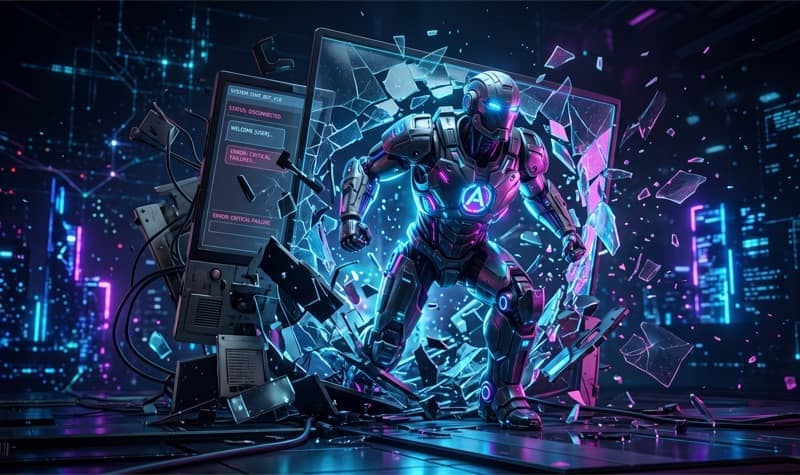
This is where Agentic AI comes in. The era of the prompt-and-response chatbot is dead. The era of the autonomous agent has arrived.
What Exactly is Agentic AI?
Agentic AI refers to artificial intelligence systems that possess "agency"—the ability to act independently to achieve a specific goal. Unlike traditional chatbots that require continuous human intervention and prompting, an AI agent can plan, reason, and execute complex workflows on its own.
Think of it this way:
- Chatbot (Passive): "Write a Python script to scrape this website for pricing data." (You have to run the script, handle the errors, format the data, and save it).
- AI Agent (Active): "Monitor our top three competitors' pricing pages every day, and if any of them drop their prices below ours, generate a report and email it to the sales team."
The agent doesn't just write the code; it is the system that executes it. It sets up the scheduler, interacts with the web via a browser or API, parses the data, formats the report, and uses an email API to send it.
Core Capabilities of AI Agents
To truly understand why Agentic AI is a game-changer, we need to look at its core capabilities:
- Autonomous Planning and Reasoning: Agents can take a complex, high-level goal and break it down into a sequence of logical steps. They use reasoning frameworks (like Chain-of-Thought) to evaluate their progress and decide what to do next.
- Tool Use and API Integration: Chatbots live in a text box. Agents live in your ecosystem. They can use web browsers, interact with databases, read and write files, execute code in secure sandboxes, and call third-party APIs (like Slack, GitHub, Jira, or Salesforce).
- Memory and Context Retention: Agents can maintain both short-term memory (for the current task) and long-term memory (recalling past interactions, user preferences, and previous project details). This allows them to build context over time.
- Self-Correction and Reflection: If an agent tries a method that fails (e.g., an API call returns a 404 error), it doesn't just stop and wait for you. It reads the error message, reflects on what went wrong, adjusts its approach, and tries again.
Why Chatbots Are Dead: The Shift from Conversation to Action
The transition from chatbots to agents represents a fundamental shift in how we interact with software. It's the move from conversation to action.
The Friction of Micro-Management
Using a chatbot for complex work requires constant micro-management. You are the orchestrator. You are the one passing data back and forth between the AI and your actual workspace. This friction severely limits the productivity gains we can achieve with AI.
Agentic AI removes the human from the middle. By granting the AI access to the tools where the work actually happens, we can delegate complete workflows rather than just isolated tasks.
The Rise of Multi-Agent Systems
One of the most exciting developments in Agentic AI is the rise of multi-agent systems. Instead of relying on a single, monolithic AI model to do everything, we are seeing ecosystems where specialized agents collaborate to achieve a goal.
Imagine a software development team composed entirely of AI agents:
- Product Manager Agent: Takes user requirements and translates them into technical specifications.
- Developer Agent: Writes the code.
- QA Agent: Writes and runs tests, sending bugs back to the Developer Agent.
- DevOps Agent: Handles deployment.
These agents communicate with each other, debate approaches, and coordinate their efforts, mimicking the dynamics of a human team.
Real-World Applications: How Agents Are Changing the Game
Agentic AI isn't just a theoretical concept; it's already being deployed across various industries.
1. Software Engineering
AI coding assistants are evolving from auto-complete tools into autonomous software engineers. Agents can now take a Jira ticket, analyze the entire codebase, write the necessary code, create tests, and open a Pull Request. They can autonomously hunt for bugs, refactor legacy code, and manage dependencies.
2. Marketing and Sales Automation
Marketing agents can autonomously run A/B tests on landing pages, tweak ad copy based on real-time performance metrics, and orchestrate complex email drip campaigns. Sales agents can research prospects, draft hyper-personalized outreach emails, and even handle initial objections before passing the qualified lead to a human rep.
3. Data Analysis and Research
Imagine asking an agent to "analyze our Q2 churn data and identify the main drivers." The agent can independently query the SQL database, clean the data, run statistical models, generate visualizations, and compile a comprehensive report—all without you writing a single line of SQL or Python.
4. Customer Support
While chatbots have long been used in customer support, they are often limited to FAQs. Agentic support systems can actually resolve issues. If a customer wants a refund, the agent can check the policy, verify the purchase in Stripe, process the refund via API, and update the CRM—completing the entire workflow autonomously.
The Challenges Ahead: Safety, Control, and Trust
Of course, granting autonomous systems the ability to act on our behalf comes with significant challenges.
- Hallucinations vs. Actions: When a chatbot hallucinates, you get a funny or incorrect text response. When an agent hallucinates, it might accidentally delete a production database or send an inappropriate email to a client. The stakes are much higher.
- The Alignment Problem: How do we ensure that an agent's actions perfectly align with our intentions? Creating robust guardrails, implementing human-in-the-loop checkpoints, and developing verifiable logging systems are critical.
- Security and Permissions: Giving an AI access to internal APIs, financial systems, and private data requires a massive overhaul of security protocols. Principle of least privilege must be strictly enforced.
Conclusion: Embrace the Autonomous Future
The death of the chatbot is not something to mourn; it's something to celebrate. It means we are finally moving beyond the novelty of talking to machines and entering a phase where machines can truly work for us.
Agentic AI promises to unlock unprecedented levels of productivity, allowing humans to step back from execution and focus on strategy, creativity, and high-level direction. The transition won't happen overnight, and there are substantial hurdles to overcome. But the trajectory is clear: the future of software isn't a conversational interface; it's an autonomous agent.
Are you ready to stop chatting and start delegating? The era of Agentic AI is here.
Swayam tests AI tools, gadgets, and developer platforms hands-on before writing about them. His work focuses on making complex tech approachable — without the hype. He has covered over 75 products across AI, gadgets, and software for TechPixelly.