Google's AI Search Agents: 24/7 Web Monitoring Explained
Quick Summary
Google's AI search agents are autonomous programs that continuously scan the web on your behalf—monitoring price drops, new listings, breaking news, or any other time-sensitive information you care about. Built on top of Google's Gemini infrastructure, they can notify you the moment something changes, even while you sleep. In this guide, we break down exactly how they work, what you can do with them today, and how they compare to other AI monitoring tools on the market.
The Internet Never Sleeps—But You Have To
Think about the last time you refreshed a page obsessively. Maybe it was airline tickets the week before a holiday. Maybe it was a sold-out sneaker drop. Maybe it was a house listing in a neighborhood you'd been stalking for months. You kept hitting F5, hoping to catch the moment something changed—and mostly you missed it.
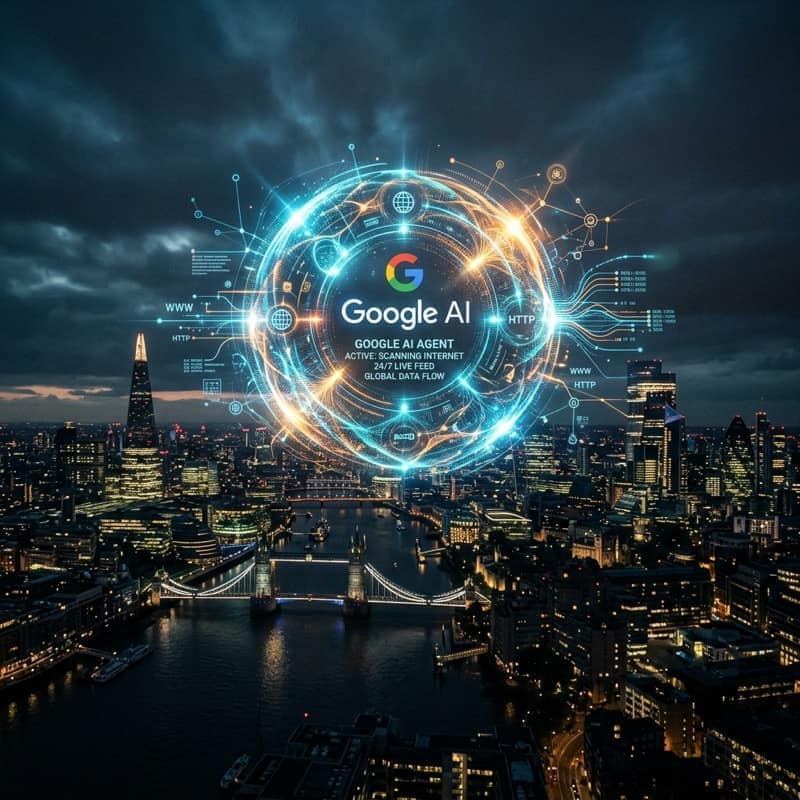
That problem is officially over. Google's AI search agents don't sleep, don't take breaks, and don't need a coffee before they start working. They are always-on digital scouts that watch the web for you, 24 hours a day, seven days a week.
But what exactly are these agents, how do they work under the hood, and are they actually useful yet? Let's dig in.
What Are Google's AI Search Agents?
Google announced its AI search agents as part of the broader rollout of AI Overviews and the Gemini-powered Search experience. Unlike traditional Google Alerts—which send you an email when Google indexes new content matching a keyword—AI search agents are proactive, context-aware, and capable of taking multi-step actions.
Here's the key distinction:
- Google Alerts → Passive. Waits for Google to crawl and index new content, then emails you.
- AI Search Agents → Active. Continuously monitors sources, understands context, synthesizes changes, and notifies you intelligently.
The agents are trained to understand intent, not just keywords. If you tell an agent to "monitor the price of a round-trip flight from Mumbai to London in October," it doesn't just search for that phrase—it reasons about flight prices, tracks fluctuations across booking platforms, and alerts you when a meaningful drop occurs.
How Do They Actually Work?
Under the hood, Google's AI search agents are powered by Gemini 2.0 (and its successors), Google's most capable multimodal large language model. Here's a simplified breakdown of the architecture:
1. Task Ingestion and Goal Setting
When you configure an agent, you describe what you want monitored in natural language. Google's system parses that into a structured goal—defining the data sources to watch, the type of change to look for, and the threshold for notification.
2. Continuous Web Crawling and Indexing
Google already has the most sophisticated web crawler on the planet. AI search agents tap directly into this infrastructure, but with a prioritized, targeted crawl focused on your specific monitoring goal rather than the general web.
3. Change Detection and Reasoning
This is where the AI magic happens. Rather than simple string-matching, Gemini evaluates whether a change is meaningful in context. A price that drops by $2 on a $1,200 flight might not warrant a notification—but a $180 drop absolutely does. The agent learns your preferences over time to calibrate these thresholds.
4. Synthesis and Notification
When a meaningful change is detected, the agent doesn't just fire off a raw data dump. It synthesizes the information into a readable summary—"The round-trip Mumbai–London flight you're tracking dropped to ₹64,000 on Air India. This is 22% below the 30-day average."—and delivers it via Google's notification infrastructure.
What Can You Actually Monitor?
Google's AI search agents are impressively versatile. Here are some of the most popular use cases people are already deploying them for:
✈️ Travel and Flights
Track fare drops on specific routes, watch for availability changes on sold-out trains, or monitor hotel prices for a specific destination window. The agents understand seasonality and can even flag when a price is historically low versus just "lower than yesterday."
🏠 Real Estate
This might be the single most powerful use case. Property listings move fast in competitive markets. An AI agent monitoring Zillow, Realtor.com, or local MLS aggregators can alert you within minutes of a new listing that matches your criteria—before the open house is even posted.
🎟️ Event Tickets
Concert tickets. Sports playoffs. Theater. These sell out in seconds, and the secondary market is brutal. AI agents can monitor resale platforms and alert you when prices fall to your target range, or when a seller drops inventory.
📈 Stock and Crypto Signals
While Google's agents aren't brokerage tools, they can monitor financial news, regulatory filings, and market commentary relevant to specific assets you're watching, giving you an information edge.
📰 Competitive Intelligence
For businesses and marketers, monitoring competitor websites for pricing changes, product launches, or blog content has historically required expensive SaaS tools. AI search agents democratize this—you can watch a competitor's pricing page and be notified the moment it changes.
🔬 Research and Academic Content
Researchers can configure agents to monitor preprint servers like arXiv, track citations for specific papers, or alert them when a particular author publishes new work.
How to Set Up a Google AI Search Agent
As of mid-2026, AI search agent functionality is being rolled out through Google Search Labs and the Gemini app. Here's how to get started:
-
Enable AI Overviews and Agent Features — Head to labs.google.com and opt into the latest experimental features. Make sure you're signed into a Google account.
-
Open Gemini or Google Search — In the Gemini app or the AI Mode in Google Search, look for the "Monitor" or "Track" option when performing a search.
-
Describe Your Monitoring Goal — Type your monitoring goal in plain English. Be specific: "Notify me when MacBook Pro 16-inch M4 Pro drops below $2,000 on Amazon or Best Buy."
-
Set Notification Preferences — Choose how you want to be notified (push notification, email, or in-app alert) and how frequently you want updates.
-
Review and Activate — The system will confirm its understanding of your goal and show you the data sources it plans to monitor. Review this, refine if needed, and activate.
You can manage all active agents from the Gemini dashboard, where you'll see a live feed of detected changes and a history of notifications sent.
Google AI Agents vs. The Competition
Google isn't the first to build web monitoring tools, but it may be the most powerful player in this space given its search infrastructure. Here's how it stacks up:
| Feature | Google AI Agents | Competitors |
|---|---|---|
| Web Coverage | Comprehensive (Google's index) | Varies by tool |
| Natural Language Setup | Yes | Some |
| Context-Aware Alerts | Yes (Gemini-powered) | Limited |
| Price | Free (with Google account) | Often $10–$50/month |
| Real-Time Speed | Near real-time | Minutes to hours |
| Customization | High | Varies |
For lightweight monitoring, Google's offering is hard to beat on price alone. For highly specialized workflows—particularly e-commerce monitoring or enterprise competitive intelligence—dedicated tools may still have an edge.
- ✓ Pixel-level change detection
- ✓ email/SMS/Slack alerts
- ✓ no-code setup
- ✓ visual diff reports
- ✗ Doesn't use AI for context reasoning
- ✗ limited free tier
Privacy Considerations: What Is Google Watching?
Anytime you hand a tech giant a long-running monitoring task, privacy questions are reasonable. Here's what we know:
- Data retention — Google states that monitoring queries are stored in your Google account history and subject to the same retention policies as standard search history. You can delete them at any time.
- What Google sees — The agent has access to publicly available web content. It doesn't access private sites, your email, or third-party accounts unless you explicitly grant permissions via Google's integration ecosystem.
- Ad targeting — It would be naive to think Google learns nothing from your monitoring goals. If you're tracking MacBook prices, expect MacBook ads. This is the implicit cost of a free service.
For users who want monitoring without Google knowing about it, dedicated tools with stronger privacy policies may be preferable.
The Bigger Picture: Agentic AI Is Changing How We Use the Web
What makes Google's AI search agents genuinely significant isn't any single feature—it's the paradigm shift they represent.
For most of the internet's history, you were the agent. You searched. You browsed. You refreshed. You tracked. The internet was a passive library, and you were the librarian doing all the work.
Agentic AI flips this model. You define a goal once, in plain language, and the AI does the continuous work of tracking it. The web becomes less like a library you visit and more like a living data stream that reports to you.
This is only the beginning. As Google integrates agents more deeply with Gmail, Calendar, Maps, and Shopping, the possibilities expand dramatically. Imagine an agent that not only tracks flight prices but automatically blocks time on your calendar, drafts a leave request to your manager, and reserves the flight when all your conditions are met.
We're not fully there yet. But the architecture is being laid right now.
Limitations to Know Before You Rely on Them
As promising as this technology is, it's worth being clear-eyed about current limitations:
- Not 100% real-time — Despite the "24/7" framing, there can be latency. Highly competitive markets (concert tickets, flash sales) still sometimes move faster than agent detection cycles.
- Coverage gaps — Sites that block Google's crawler or rely heavily on JavaScript rendering may not be monitored as accurately.
- False positives — Agents can occasionally surface noise—minor wording changes on a webpage flagged as significant. Tuning is still required.
- US-heavy rollout — As of writing, full agent functionality is most robust for users in the United States, with international availability expanding gradually.
Final Thoughts
Google's AI search agents are one of the most practically useful applications of large language models to hit everyday consumers. They solve a real problem—the exhausting task of manually tracking time-sensitive information on the web—and they do it with the backing of the most powerful search infrastructure ever built.
If you haven't explored them yet, now is the time to sign up for Google Search Labs and run your first monitoring experiment. Start simple: track a product you've been eyeing or a news topic you care about. Get a feel for how the notifications land and how accurate the change detection is.
The era of passive search—where you come to Google—is giving way to something more powerful: search that comes to you.
Have you tried Google's AI search agents? Drop your experience in the comments below. And if you found this post helpful, share it with someone who still manually refreshes flight price pages.
Swayam tests AI tools, gadgets, and developer platforms hands-on before writing about them. His work focuses on making complex tech approachable — without the hype. He has covered over 75 products across AI, gadgets, and software for TechPixelly.