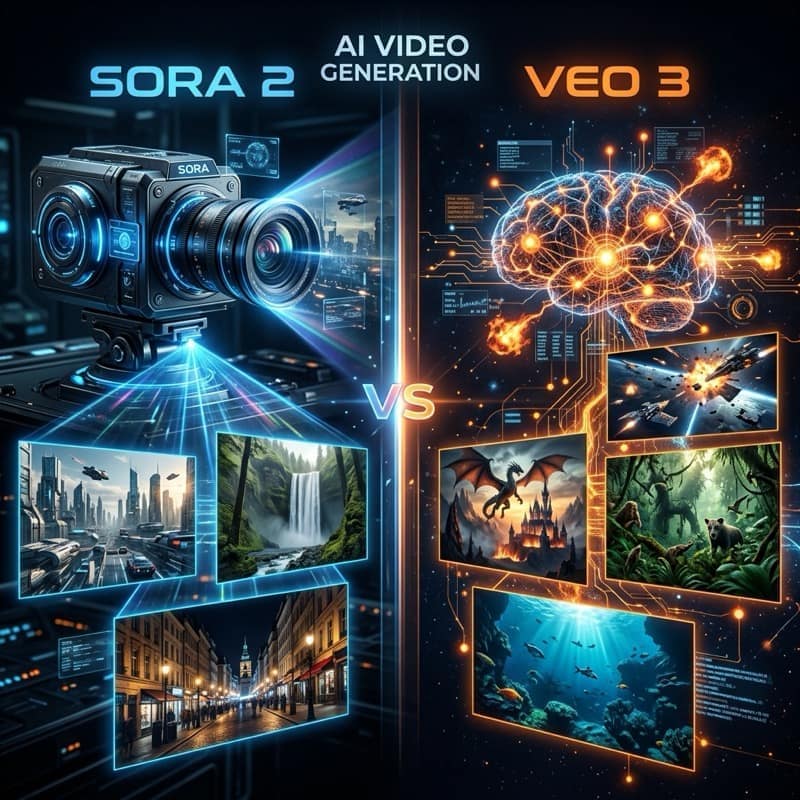
AI Video Generation: Sora 2 vs. Veo 3
The landscape of generative AI has evolved at a breakneck pace, and nowhere is this more evident than in the realm of AI video generation. What started as blurry, low-resolution, and often horrifyingly mutated clips just a few years ago has blossomed into a multi-billion dollar industry capable of producing cinema-quality footage from a simple text prompt. In 2026, two monolithic models dominate the conversation: OpenAI's highly anticipated Sora 2 and Google DeepMind's powerhouse, Veo 3.
In this massive 2000-word comparative guide, we will break down the architectures, capabilities, strengths, and weaknesses of both models. Whether you are an independent filmmaker, a marketing agency executive, or a casual creator looking to harness the power of AI, this article will give you everything you need to know to make an informed decision between Sora 2 and Veo 3.
The Evolution of AI Video Generation
Before diving into the intricacies of these two leading models, it's essential to understand the context of their development. The journey from rudimentary GAN-based video generation to modern diffusion and transformer architectures has been exponential.
Early models struggled primarily with temporal consistency. A character's face might morph drastically from one frame to the next, or physics would break down completely, causing objects to melt into the background. The first iteration of Sora sent shockwaves through the industry by demonstrating unprecedented temporal consistency and a grasp of physical dynamics. Meanwhile, Google's earlier Veo models pushed the boundaries of multi-modal understanding and high-fidelity rendering.
Now, with Sora 2 and Veo 3, we are no longer just looking at "good for AI." We are looking at "good enough for Netflix." These models are capable of generating ultra-realistic 4K video, complex camera movements, nuanced emotional expressions, and accurate physics, all while adhering strictly to complex user prompts.
Deep Dive: OpenAI's Sora 2
OpenAI's Sora 2 builds upon the phenomenal success of its predecessor. It is a diffusion transformer model that treats video generation similarly to how LLMs treat text generation—by breaking down videos into "patches" (analogous to tokens) and learning the relationships between them across space and time.
Architecture & Key Features
Sora 2 utilizes a significantly larger parameter count than the original Sora, paired with an upgraded diffusion transformer (DiT) architecture. This allows it to process and generate vastly more complex scenes.
- Extended Context Window: Sora 2 can generate continuous, coherent videos up to three minutes in length, a massive leap from the original 60-second limit.
- Native 4K & 120fps: The output quality has been drastically improved, offering native 4K resolution at up to 120 frames per second, making it ideal for slow-motion and high-end cinematic sequences.
- Multi-Angle Generation: Sora 2 can generate multiple camera angles of the exact same scene simultaneously, allowing editors to cut between wide shots, close-ups, and tracking shots seamlessly.
- Enhanced Audio Integration: Partnering with advanced audio generation models, Sora 2 now generates highly synchronized, diegetic audio natively alongside the video.
Strengths
The most significant strength of Sora 2 is its cinematic aesthetic. Out of the box, Sora 2 produces footage that looks like it was shot on ARRI Alexa cameras with expensive anamorphic lenses. The lighting, depth of field, and color grading are incredibly sophisticated.
Furthermore, Sora 2 excels at understanding complex, multi-layered prompts. If you ask for "a cyberpunk street market in the rain, reflecting neon lights, as a robotic cat chases a cyber-mouse through the crowd, tracking shot, 35mm lens," Sora 2 not only gets all the elements right but composites them flawlessly.
Weaknesses
Despite its prowess, Sora 2 is not without flaws. It still occasionally struggles with complex fluid dynamics (e.g., splashing water interacting with complex geometry) and extremely fast, chaotic motions. Additionally, the computing power required to generate a 3-minute 4K clip is substantial, leading to high generation costs and longer wait times for users on lower-tier subscription plans.
Deep Dive: Google DeepMind's Veo 3
Google DeepMind's Veo 3 takes a slightly different approach. Deeply integrated with the Gemini ecosystem, Veo 3 is built on a massive multimodal architecture designed to understand not just text, but images, audio, and physical concepts simultaneously.
Architecture & Key Features
Veo 3 leverages Google's vast computational resources and its mastery of multimodal learning. It utilizes an advanced latent diffusion architecture intertwined with a physics-informed neural network.
- Physics-Grounded Rendering: Veo 3 is specifically trained on physical simulations. This means it understands gravity, collision, mass, and fluid dynamics far better than most competing models.
- Infinite Generation (Looping & Extension): Veo 3 excels at seamlessly looping videos or extending them infinitely without degrading quality or losing the core context of the scene.
- Hyper-Realistic Textures: Where Sora leans cinematic, Veo leans photorealistic. The textures on skin, fabric, and natural environments (like bark and leaves) are staggeringly detailed.
- Interactive Prompting: Veo 3 allows for localized prompting. Users can highlight a specific region of a generated video and type a new prompt just for that area (e.g., "change the color of the car to red" or "make the person smile").
Strengths
Veo 3's greatest asset is its physical accuracy and control. Because it incorporates physics-informed rendering, actions like a glass shattering on the floor or a person interacting with a complex object look completely natural. The model rarely produces the "melting" artifacts that plague other AI video generators during object interactions.
Moreover, the localized editing capability makes Veo 3 a much more powerful tool for actual production workflows. Instead of re-rolling an entire generation because one minor detail is wrong, creators can precisely edit the existing video.
Weaknesses
While technically brilliant, Veo 3 sometimes lacks the immediate "wow" factor of Sora 2's cinematic defaults. Getting a truly artistic, heavily stylized shot often requires much more detailed prompting compared to Sora 2. Furthermore, its integration heavily ties it to the Google Cloud and Gemini Advanced ecosystem, which might not be preferred by creators heavily invested in other platforms.
Head-to-Head Comparison
To truly understand which model is right for you, we need to pit them against each other in a head-to-head showdown across several critical categories.
Visual Fidelity & Realism
Winner: Tie This comes down to stylistic preference. Sora 2 wins easily if you want cinematic, movie-like quality with dramatic lighting, lens flares, and beautiful bokeh. It feels like magic. Veo 3 wins if you need documentary-style photorealism, where every pore on a person's face and every thread on their jacket needs to look scientifically accurate.
Physics & Consistency
Winner: Veo 3 Veo 3's physics-informed neural network gives it a distinct edge here. Sora 2 is excellent, but if you prompt complex physical interactions—like two people wrestling, or a complex machine functioning—Sora 2 might occasionally merge limbs or gears. Veo 3 maintains object permanence and physical boundaries with remarkable rigidity.
Prompt Adherence
Winner: Sora 2 OpenAI's deep expertise in NLP shines through in Sora 2. It understands highly abstract, poetic, or ridiculously complex prompts better than Veo 3. If you want a surrealistic dreamscape that combines five different artistic styles, Sora 2 is more likely to nail the brief on the first try.
Processing Speed & Efficiency
Winner: Veo 3 Google's infrastructure advantage is apparent here. Using proprietary TPUs optimized specifically for this architecture, Veo 3 generates footage significantly faster than Sora 2. A 30-second 1080p clip on Veo 3 can generate in a fraction of the time it takes Sora 2.
Cost & Accessibility
Winner: Veo 3 (Slight Edge) While pricing structures change rapidly, Google has aggressively bundled Veo 3 access into its broader Google Workspace and Gemini Advanced subscriptions, making it highly accessible for enterprise users. Sora 2 operates primarily on a credit-based system which can become quite expensive for heavy, high-resolution users.
The Comparison Matrix
| Feature | Sora 2 | Veo 3 |
|---|---|---|
| Max Resolution | 4K | 4K |
| Max Frame Rate | 120 fps | 60 fps (Interpolated to 120) |
| Max Continuous Length | 3 Minutes | 2 Minutes (Infinite Extension) |
| Architecture | Diffusion Transformer | Multimodal Latent Diffusion |
| Best Aesthetic | Cinematic & Stylized | Photorealistic & Accurate |
| Audio Sync | Native Diegetic Audio | External Module Integration |
| In-Painting/Editing | Basic | Advanced Localized Editing |
| Pricing Model | High-tier Credit Based | Subscription/Usage Based |
Real-World Applications
How are these tools actually being used by professionals in 2026? The applications have moved far beyond viral social media posts.
Filmmaking & Entertainment
Indie filmmakers are using Sora 2 to generate establishing shots, complex VFX sequences, and background plates that would previously require massive budgets. Entire short films are being created entirely inside Sora 2, relying on its cinematic eye to do the heavy lifting of a Director of Photography.
Marketing & Advertising
Ad agencies are gravitating towards Veo 3 due to its localized editing features. A brand can generate a single commercial and then use Veo 3 to instantly swap out the product color, the actor's clothing, or the background language/signage to hyper-personalize the ad for dozens of different demographics, drastically reducing production costs.
Education & Training
Both models are revolutionizing e-learning. Veo 3, with its accurate physical simulations, is being used to generate medical training videos, engineering simulations, and safety demonstrations. Sora 2 is being utilized to recreate historical events with vivid realism, bringing history books to life for students.
The Ethical Implications & Deepfakes
We cannot discuss AI video generation in 2026 without addressing the elephant in the room: ethics, deepfakes, and misinformation. Both OpenAI and Google have implemented robust safety measures, but the arms race between generation and detection continues.
Both Sora 2 and Veo 3 utilize advanced, invisible watermarking technologies (like SynthID) that are permanently embedded in the metadata and pixel structure of the videos. Furthermore, both platforms aggressively filter prompts that attempt to generate non-consensual deepfakes, extreme violence, or politically sensitive misinformation involving real public figures.
However, the democratization of such powerful tools means that bad actors will constantly look for workarounds. The onus is increasingly on social media platforms and news organizations to implement real-time AI detection tools to verify the authenticity of footage. As consumers, we are having to develop a new kind of media literacy—one where seeing is no longer necessarily believing.
The Future of Generative AI Video
Where do we go from here? The jump from Sora 1 to Sora 2, and Veo 2 to Veo 3, proves that scaling laws still apply to video generation.
The next frontier is real-time generation. We are already seeing early prototypes of game engines powered entirely by AI, rendering 3D environments on the fly based on player input. Within a few years, we may see models like Sora 3 or Veo 4 capable of generating personalized, interactive movies in real-time, blurring the line completely between video games and cinema.
Furthermore, we expect to see much deeper integration with 3D workflows. Instead of just generating a flat 2D video, future models will likely output fully rigged 3D scenes, complete with geometry, lighting data, and camera paths, allowing VFX artists to import AI generations directly into software like Blender or Unreal Engine for granular manipulation.
Conclusion
Choosing between Sora 2 and Veo 3 is less about determining which model is "better" and more about determining which model is better suited to your specific needs.
If you are an artist, a storyteller, or a marketer looking for breathtaking, cinematic visuals that require minimal tweaking to look stunning, OpenAI's Sora 2 is the undisputed king. It is a magic wand for cinematic creation.
If you are a professional editor, an agency looking for hyper-realistic accuracy, or someone who needs granular control over the physics and details of a scene through localized editing, Google's Veo 3 is the superior, more utilitarian tool.
Ultimately, we are living in a golden age of digital creation. The barriers to entry for visual storytelling have never been lower. Whether you choose Sora 2 or Veo 3, the only real limit is your imagination.
FAQ
Q: Can I use Sora 2 or Veo 3 for commercial projects? A: Yes, both OpenAI and Google offer commercial licenses for content generated on their platforms, provided you adhere to their terms of service and acceptable use policies. Always check the most current licensing agreements.
Q: Do these models generate audio as well? A: Sora 2 features native diegetic audio generation that syncs with the video. Veo 3 integrates deeply with Google's audio models, though it is often handled as a secondary pass rather than natively within the video generation model.
Q: How much computing power do I need to run these? A: You don't need a supercomputer. Both Sora 2 and Veo 3 are cloud-based models. All the heavy lifting is done on OpenAI's and Google's servers. You simply need a device capable of running a modern web browser and a solid internet connection to stream the results.
Q: Which model is better for anime or 2D animation styles? A: Both models are capable of generating stunning 2D animation, but Sora 2 tends to excel at understanding specific artistic styles and anime tropes more intuitively due to its expansive NLP training.
Swayam tests AI tools, gadgets, and developer platforms hands-on before writing about them. His work focuses on making complex tech approachable — without the hype. He has covered over 75 products across AI, gadgets, and software for TechPixelly.